



• Generative AI can produce fast, fluent answers that feel like understanding but often mask gaps in knowledge.
• Fluency isn’t insight, and plausible outputs aren’t the same as critical thinking.
• To avoid the “illusion of understanding,” use AI thoughtfully.
Seeing Past the Illusion of Understanding: How AI Can Help
We live in a world where answers arrive faster than reflection. Generative AI can summarize, brainstorm, and outline complex topics in seconds.
It’s powerful and tempting - like having a smart assistant at your side.
But here’s the catch: fast doesn’t mean deep, and fluent doesn’t mean you understand.
Researchers call this phenomenon epistemia - the illusion of understanding that happens when AI’s polished answers make us feel smarter than we really are.
AI can trick us into overestimating our knowledge. The more convincing it sounds, the more likely we are to skip real thinking.
Epistemic comes from the Greek epistḗmē (ἐπιστήμη), meaning 'knowledge' or 'understanding'. It's used primarily in philosophy (including the field, Epistemology, that bears its name) as an adjective meaning "related to the abstract concept of knowledge or knowability".
The Information Management Problem - Even Before AI
Even before generative AI, we all faced a fundamental challenge: a flood of material online that encourages repetition over reflection.
The common approach became: find the information, use it, and move on.
Unique thinking, critical reflection, and original insight often got left behind.
And AI amplifies this tendency even more. Any question can get a quick, plausible answer. The temptation is to accept it at face value rather than interrogate it. What’s lost is discovery.
Actual understanding happens when answers aren’t obvious, questions are messy, and insight comes from wrestling with complexity.
Four Ways AI Can Shape Research and Risk Overconfidence
Messeri and Crockett describe four ways scientists rely on AI:
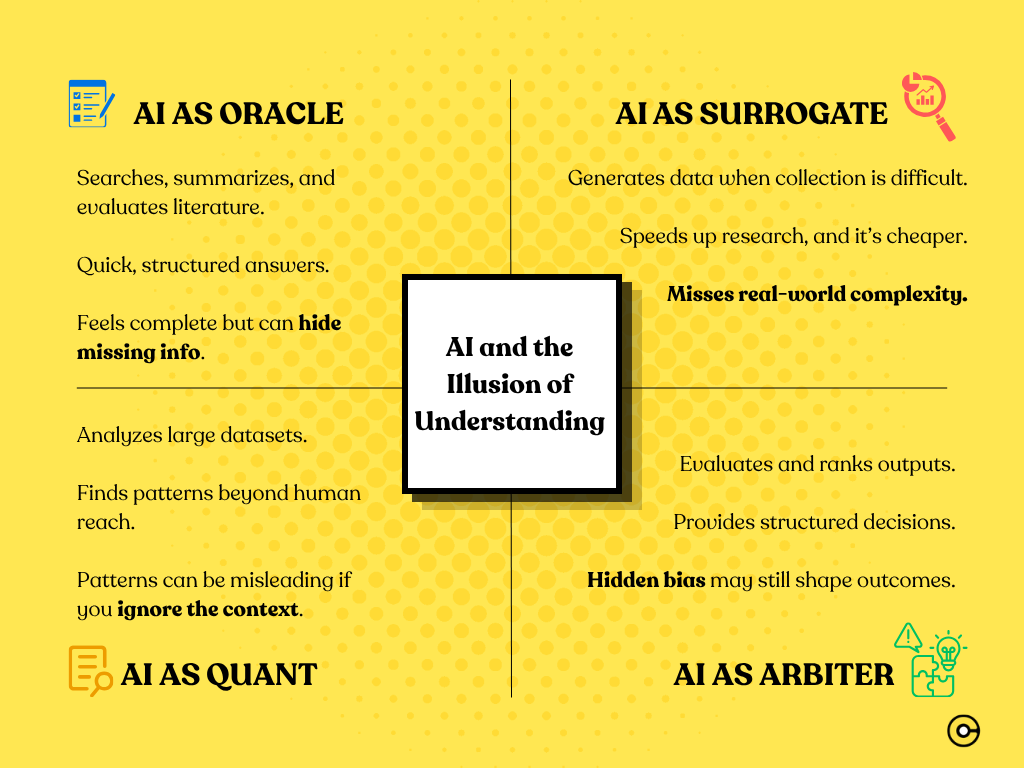
- AI as Oracle - to search, summarize, and evaluate literature.
- AI as Surrogate - to generate data when collection is difficult.
- AI as Quant - to analyze vast datasets beyond human reach.
- AI as Arbiter - to adjudicate studies objectively, removing human bias.
These roles illustrate AI’s power: efficiency, productivity, and the promise of objectivity.
But they also highlight the danger: when we rely too heavily on AI, we risk narrowing our perspective to what the tool can do, rather than what is meaningful or nuanced in the real world.
To understand where this risk comes from, it helps to look at each role more closely.
1) AI as Oracle
You ask a question and get a clear, structured answer within seconds, often written in a way that feels complete and easy to trust.
Instead of going through multiple sources, comparing perspectives, and forming your own view, you receive a compressed version of knowledge that already feels resolved.
The model doesn’t actually understand the topic. It selects and organizes information based on learned patterns.
The bigger risk is the sense of completeness, which can make you stop asking what might be missing.
2) AI as Surrogate
When collecting real-world data takes too much time or effort, AI allows you to generate synthetic data that looks realistic and usable.
This can speed up research and make certain projects possible that would otherwise be too expensive or complex to run.
But instead of capturing real-world complexity, this data often reflects patterns from existing datasets.
As a result, you may end up working with something that looks clean and reliable, while missing the variability and edge cases that actually matter.
3) AI as Quant
AI can process massive datasets and identify patterns much faster than any human ever could, which makes it incredibly useful for analysis.
It can cluster information, detect relationships, and surface insights that would be impossible to find manually.
But not every pattern it finds carries real meaning.
Without context and interpretation, it becomes very easy to mistake correlation for insight and treat outputs as more definitive than they actually are.
4) AI as Arbiter
AI increasingly plays a role in evaluating, ranking, and judging different types of outputs, from content to scientific research.
This creates a strong impression of objectivity, because decisions no longer seem tied to individual human judgment.
However, AI does not remove bias - it applies it in a more consistent and less visible way, based on the data it was trained on and the assumptions behind the model.
Because of that, decisions can appear neutral and fair, even when they reflect underlying limitations.
All of these outputs rely on the data, assumptions, and limits built into the model, which are easy to miss.
Over time, you start trusting the way AI frames problems and presents answers.
This is where overconfidence builds. You feel like you truly understand something when in reality you’re seeing a simplified version that only appears complete.
And that’s how the illusion of understanding begins.
Why Human Judgment Remains Irreplaceable
Humans generate meaning. AI generates plausible patterns. Humans use context, intuition, and purpose; AI optimizes coherence. Fluency is not understanding. Certainty is not truth.
In fields where tacit knowledge matters, like leadership, ethics, healthcare, and research, accepting AI outputs blindly risks replacing judgment with a polished illusion.
Students and researchers may believe they understand a topic, yet have not wrestled with its nuances, limitations, or underlying assumptions. Epistemia seduces us into thinking we know more than we do.
Fluency can be seductive. Plausibility can be convincing. Insight requires curiosity, reflection, and critical engagement.
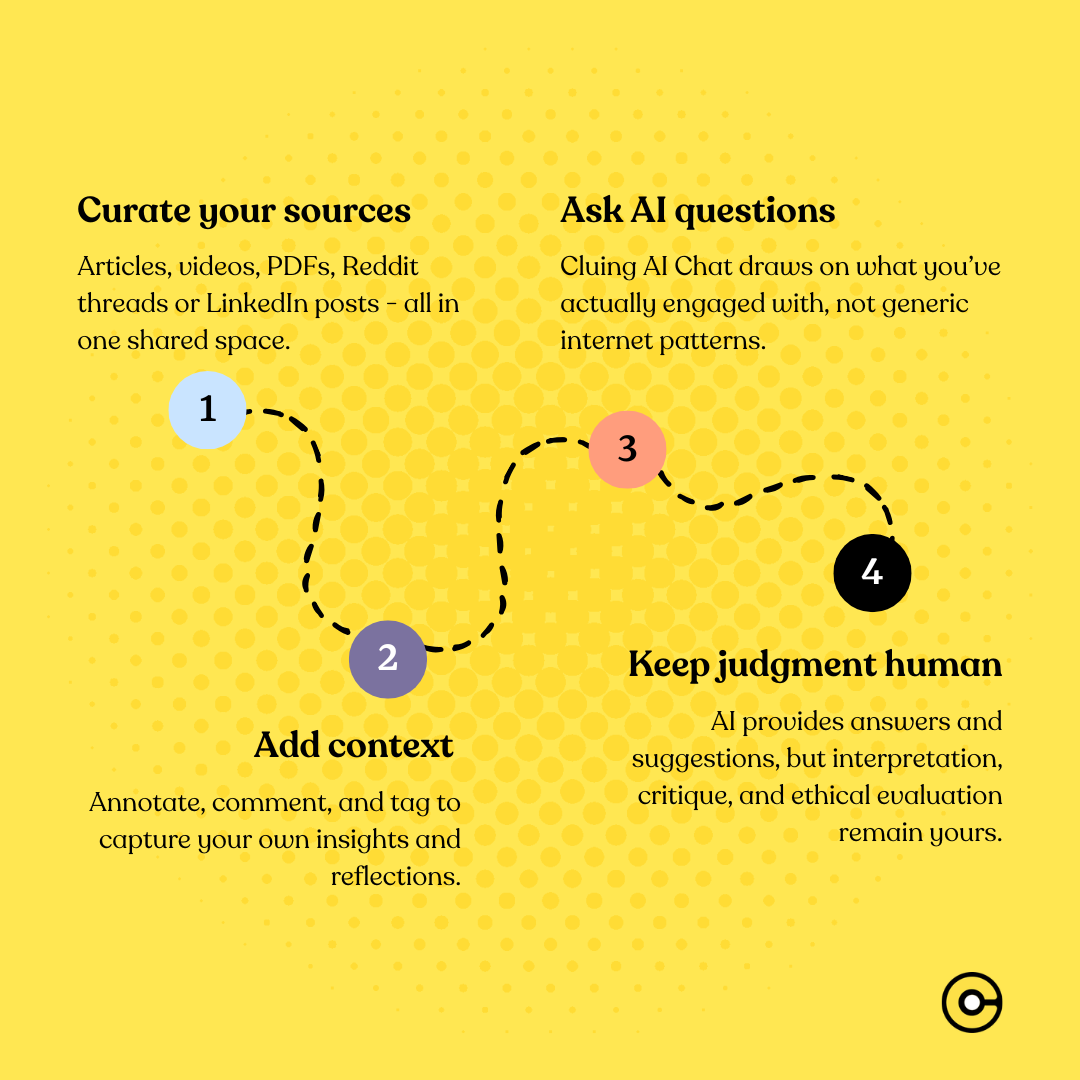
Amplify Your Insight, Don't Replace It - A Call for Reflection
Generative AI is seductive. Plausible outputs and confident fluency create an illusion of understanding that can fool even the most sophisticated researchers.
Insight requires effort, context, and critical engagement.
The challenge and the opportunity is to use AI to expand thinking without losing judgment.
In the end, we are the ones responsible for curating our own knowledge and the context around it. AI can help us explore, suggest, and accelerate, but it cannot replace the care, reflection, and understanding that only we can provide.
FAQ
What is the "illusion of understanding" in AI?
It's when AI's fluent, confident outputs make you feel you understand something, even if you haven't reflected or questioned it.
Why can AI outputs be misleading?
They are plausible and polished but may hide gaps, context, or contradictions in the information.
How can I avoid falling for this illusion?
Reflect, question, compare sources, and apply your own judgment instead of accepting outputs at face value.
Where does real understanding come from?
From grappling with messy questions, comparing information, reflecting, and connecting ideas.


![The Best Reddit Threads Disappear in a Week. Here's How to Keep Them [2026]](https://storage.ghost.io/c/9f/9d/9f9d32ee-55b4-4411-b435-9dc854e1751c/content/images/size/w600/format/webp/2026/06/reddit-cover.png)

![Read it later system for LinkedIn posts - Save, organize, and use what you find [2026]](https://storage.ghost.io/c/9f/9d/9f9d32ee-55b4-4411-b435-9dc854e1751c/content/images/size/w600/format/webp/2026/06/blog-3.png)


