


![The New Layer of Value - Cognitive Capital 2026 [definition, examples and how to build one]](https://storage.ghost.io/c/9f/9d/9f9d32ee-55b4-4411-b435-9dc854e1751c/content/images/size/w2000/format/webp/2026/05/covers--9-.png)
A new era of value beyond tools
For a long time, we measured success by what we could build or touch. First it was factories. Then software. Then data. Now we’re hitting a different point.
Everyone has access to the same tools. The same AI. The same information. So the tools aren’t what make you different anymore.
What matters is how you think with them. Because having access to answers is not the same as knowing what to do with them. Some people open an AI prompt and get stuck. Others use the same tools and move ten times faster.
The difference isn't raw intelligence. It isn't just working harder either. It's the way they capture, connect, and use what they learn. That's what compounds, and that's what turns raw information into your unique context, which you can actually build on.
We used to call this experience. Now it has a different shape. You could call it cognitive capital. It's the part of you that actually compounds over time only if you keep building on it.
So what does cognitive capital actually look like?
What we actually mean by cognitive capital
Cognitive capital is the value of how intelligence grows over time. It’s what happens when human thinking, machine learning, and adaptive systems start working together instead of separately.
It exists on two levels at once: individual and collective.
Every person who learns, every system that improves, every tool that helps us think better adds to something bigger - the overall thinking capacity of a society.
You can think of it as a kind of cognitive GDP. Not what we produce with our hands, but what we’re able to understand, solve, and create together.
In this system, knowledge is no longer just a side effect of work. It becomes the main input.
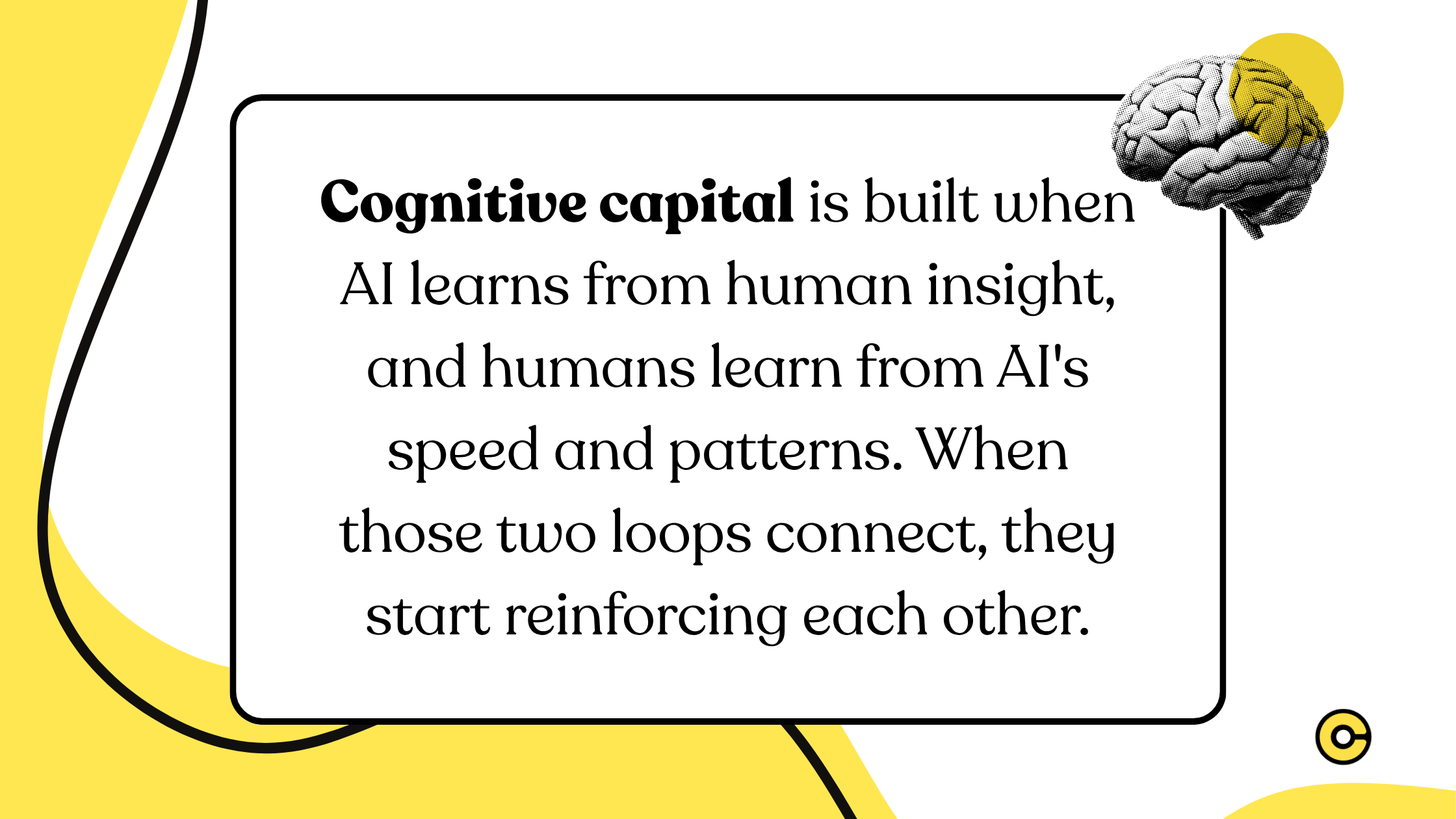
Cognitive capital is built when AI learns from human insight, and humans learn from AI speed and patterns. When those two loops connect, they start reinforcing each other.
And that loop - the back and forth between human and machine thinking - is what makes intelligence compound faster than any system we’ve had before.
Where does cognitive capital actually come from in real life?
Most people feel like they’re learning all the time.
They read things, save links, watch videos, and take in more information than ever before. But if you look closely, most of it doesn’t really connect. Something feels interesting for a moment, and then it gets lost in everything else. That’s the gap.
Cognitive capital doesn’t come from how much you consume. Not from having more sources, or more tools, or more information.
It comes from what happens after you learn something.
It grows when you revisit ideas. When you connect one thought to another. When something you read weeks ago suddenly helps you understand something today.
That’s where it starts to compound.
Because isolated information doesn’t grow. It just sits there, but connected information behaves differently. It builds on itself over time.
And that’s the real shift today. Not learning more, but letting what you learn stay with you long enough to become useful again.
If you had to put it in simple words, the difference between “learning” and building cognitive capital is simple:
One stops when you close the tab. The other keeps going after it.
 Gordana Laskovic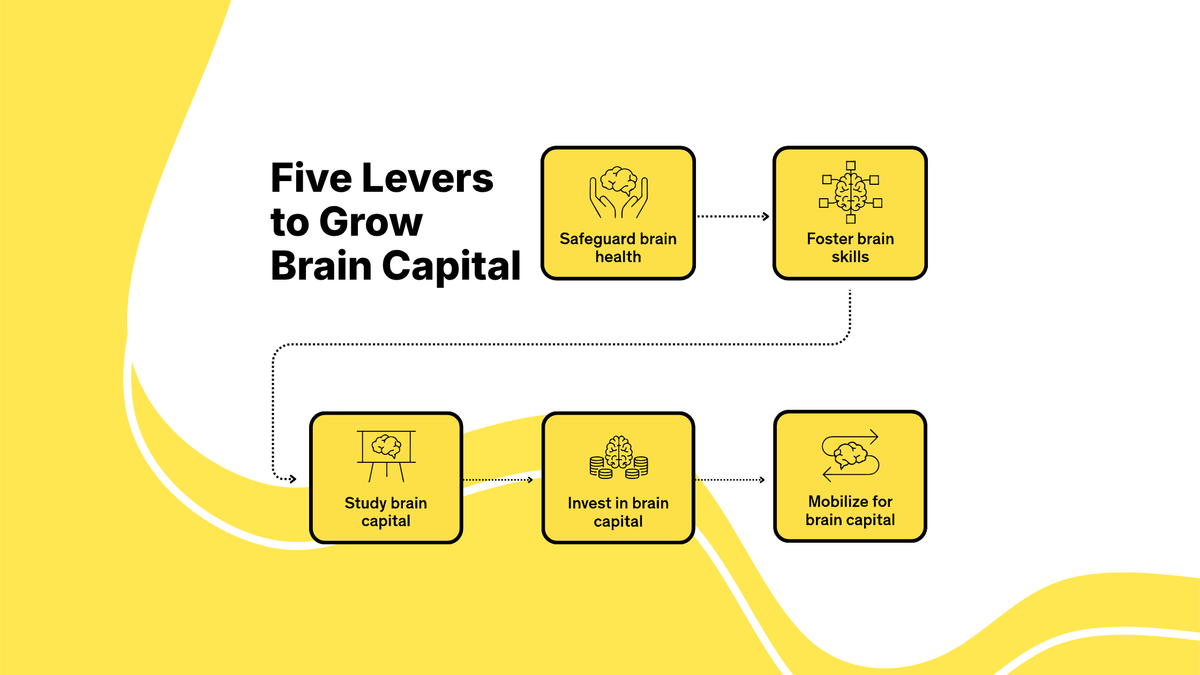
Why most people never build cognitive capital - The missing layer
What most people actually struggle with is not learning, but continuity.
We live in a world of constant input. Our days are filled with articles, videos, and endless scrolls - more information than any generation has ever had to process.
But very little of that knowledge survives the transition from one day to the next.
Instead, our insights end up scattered across browser tabs, forgotten bookmarks, and buried notes. This fragmentation creates a kind of mental friction. It kills momentum. When nothing connects, nothing builds.
You might spend hours learning every day, yet your perspective never truly evolves. You’re essentially hitting a "reset" button every night.
Real growth requires more than just exposure to new ideas. It happens when those ideas stay linked - when a concept you picked up today actually shapes the way you solve a problem tomorrow.
Without that bridge, learning remains temporary and isolated. But when you build for continuity, your knowledge stops being a pile of facts and starts becoming an engine.
It begins to stack. It begins to compound. And eventually, it becomes the most valuable asset you own.
How to build cognitive capital (and start thinking this way)
You don’t really build cognitive capital by simply learning more or trying to consume as much information as possible.
You build it by slowly changing your relationship with the information you engage with, which means becoming more intentional about what you consume.
Most people move through information only once. They read something, watch something, save it somewhere, and then immediately move on to the next thing, and over time, it all just fades into the background without ever being used again.
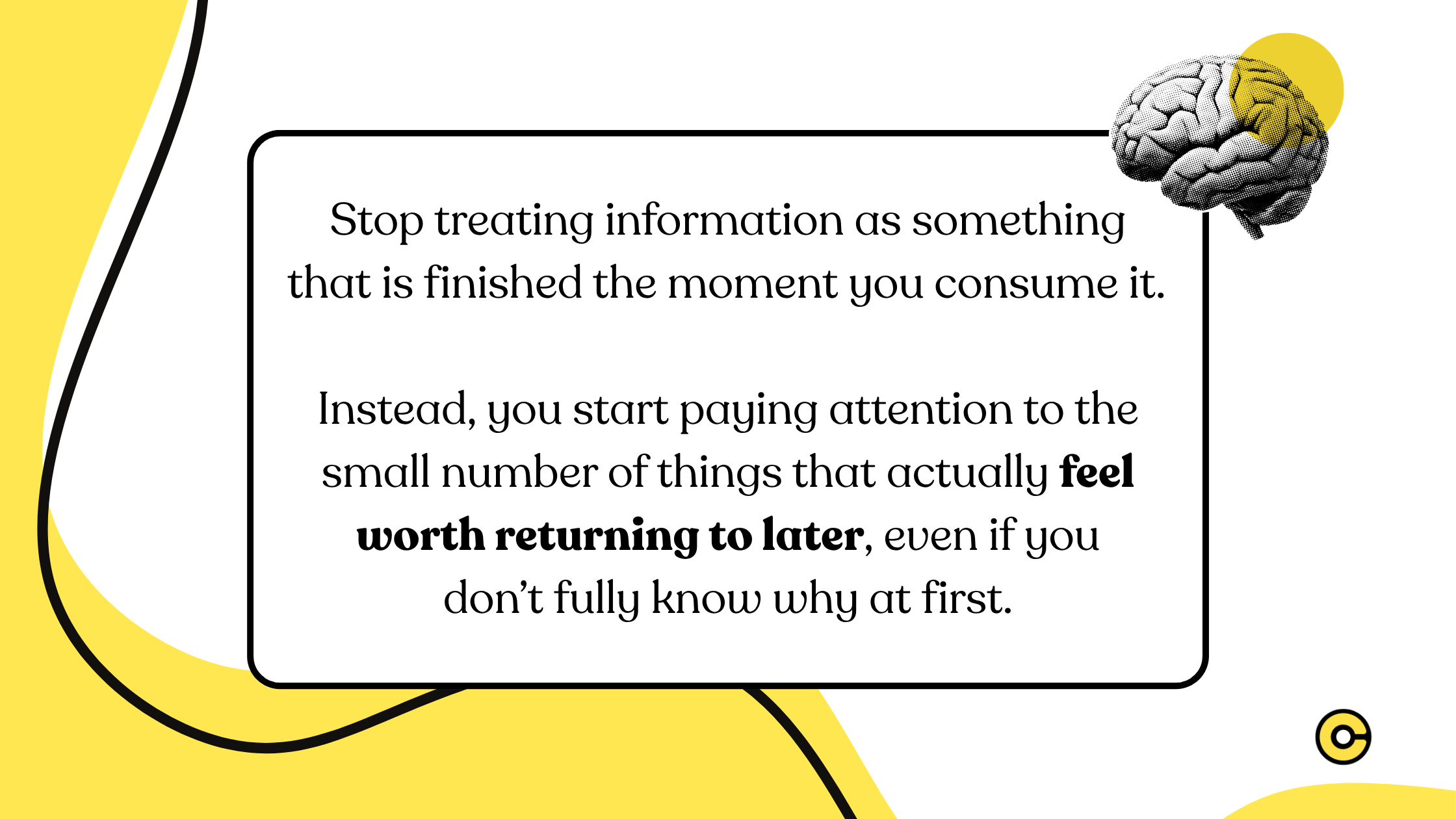
So the first shift is actually quite simple: you stop treating information as something that is finished the moment you consume it.
Instead, you start paying attention to the small number of things that actually feel worth returning to later, even if you don’t fully know why at first.
And then you start giving those things a second life instead of letting them disappear.
You revisit them after some time has passed, you connect them to other ideas you’ve seen in completely different contexts, and you start asking yourself whether they still make sense when placed next to something new.
Over time, something subtle starts to change in the way you think.
Ideas stop existing as isolated moments that come and go, and instead they begin to overlap, reinforce each other, and build a kind of internal structure.
Something you read last week suddenly becomes relevant to how you understand a problem today, and two completely unrelated thoughts start pointing toward the same insight without you forcing it.
That is where cognitive capital actually starts to form. Not from collecting more information, but from allowing a smaller amount of it to stay alive long enough to be reused in different moments and contexts.
What changes when you start thinking this way
At first, nothing really changes in an obvious or dramatic way.
You are still reading the same things, following the same topics, and moving through the same flow of information as before.
But slowly, your attention begins to shift in a very subtle way, where you stop consuming everything at the same speed and start noticing that some things tend to stay with you longer than others.
You begin to recognize patterns in what actually sticks in your mind, instead of assuming everything you read has the same weight.
Over time, you stop treating ideas as one-time inputs that exist only in the moment you encounter them. You start returning to them more often, reusing them in different situations, and building on them instead of starting from zero every time.
And that’s the moment when something important changes: Your thinking stops resetting all the time, and instead it slowly starts continuing from where it left off.
Where this leaves us
Nothing about how we access information is going back.
AI will keep getting better. Answers will keep getting faster. The cost of information will keep going down.
But that does not mean everyone moves forward at the same pace.
If anything, the gap becomes more visible. Because when everyone has access to the same inputs, the only difference left is what actually carries forward.
Some people will keep moving through information the same way. They will read, watch, ask, and move on. Each day starting from zero, even if it feels productive in the moment.
Others will start building on what they already know. They will return to ideas, connect them, and let them shape how they think over time.
The difference is quiet, but it compounds.
And over time, it becomes very hard to ignore. Because in a world where answers are cheap, the real value is not in what you can get instantly. It’s in what stays with you, connects over time, and continues to grow.
That is where cognitive capital lives. And that’s what starts to separate how people think, decide, and move forward in this new environment.
At some point, you realize this does not happen by accident.
Thinking needs a place where it can accumulate. A place where ideas are not just stored, but stay connected over time and can still be found and used when they become relevant.
That’s why people start building systems around how they learn and think. Not to collect more information, but to make sure what they already have doesn’t slowly disappear or lose its context.
Once thinking has a place where it can continue, it stops resetting every time you come back to it. Instead of starting from zero again and again, it starts building on itself. That’s when it begins to compound.
FAQs 🧐
What is cognitive capital?
Cognitive capital is the value that comes from how your thinking grows over time. It is not about how much you know, but how well your ideas connect, evolve, and stay useful as you learn new things.
Is cognitive capital the same as knowledge?
Not exactly. Knowledge is what you learn. Cognitive capital is what happens when that knowledge starts connecting, stacking, and influencing how you think in different situations.
Why is cognitive capital important in the age of AI?
Because AI makes information easy to access, but it does not automatically make you understand what to do with it. The advantage shifts from having answers to being able to think with them.
Can everyone build cognitive capital?
Yes. It is not tied to intelligence or profession. It comes from how you engage with what you read, hear, and think about, and whether you let those ideas build on each other over time.
What stops people from building cognitive capital?
Most people consume information without ever returning to it. When ideas are not revisited or connected, they stay isolated and quickly fade instead of compounding.
Do I need tools or systems to build cognitive capital?
Not necessarily. Tools like Cluing can help, but the core shift is behavioral. It is about slowing down the “one-time consumption” loop and allowing ideas to stay active and reusable.


![The Best Reddit Threads Disappear in a Week. Here's How to Keep Them [2026]](https://storage.ghost.io/c/9f/9d/9f9d32ee-55b4-4411-b435-9dc854e1751c/content/images/size/w600/format/webp/2026/06/reddit-cover.png)

![Read it later system for LinkedIn posts - Save, organize, and use what you find [2026]](https://storage.ghost.io/c/9f/9d/9f9d32ee-55b4-4411-b435-9dc854e1751c/content/images/size/w600/format/webp/2026/06/blog-3.png)


