



I recently came across an interesting quote on LinkedIn:
Share 100% of your knowledge. Not 98%. Not 99%. All of it.
It seems the lessons from childhood, like sharing is caring, are still worth remembering. Our parents and teachers encouraged us to share our toys, knowledge, and other things with friends and classmates.
But as we grow older, we realize that not everyone likes to share knowledge, especially at work.
Why is this wrong, and how can you prevent it, we'll discuss this in this article.
What is knowledge hoarding?
Knowledge hoarding (also referred to as information hoarding) happens when people keep helpful information to themselves instead of sharing it with colleagues. Sometimes, individuals gather knowledge just for personal benefit, without realizing how useful it could be to others.
When knowledge is hoarded, productivity suffers, duplicate work increases, and different teams can become misaligned.
An information hoarder at work might be someone who keeps process documentation to themselves, never writes down how they solve recurring problems, or avoids sharing research findings outside their immediate circle.
On the flip side, a culture of knowledge sharing helps everyone see the bigger picture, collaborate more effectively, and build strong relationships. This not only improves the employee experience but also leads to better customer satisfaction.
So, if sharing knowledge is so beneficial, why do many organizations still struggle with it?
5 reasons why employees hoard knowledge
Some employees think hoarding information makes them indispensable. Others worry that sharing will make them seem less capable. Some see knowledge as a source of power and control.
Beyond individual motivations, structural factors play a big role: lack of trust, no rewards for sharing, a competitive atmosphere, and being overwhelmed with tasks can all make sharing feel like a low priority.
Here are the five most common root causes.
1) Personal reasons (job security and status)
Some employees see knowledge as power. They may believe they're more secure in their job if they're the only ones with certain expertise. Or they enjoy being known as the go-to expert for specific problems - the person no one can afford to lose.
This mindset is understandable, but it creates fragility for the entire team.
2) Lack of trust
According to PwC's 2024 Trust Survey, only 67% of employees say they highly trust their employer - despite 86% of business executives believing that trust is high. That's an 18-point gap, and it's been growing year over year. Even more telling: 61% of employees agree that this perceived lack of trust directly impacts their ability to do their jobs well.
Additionally, a 2023 Slack research reveals that trust is a key driver of workplace productivity.
When employees don't trust their employer, they're less likely to share knowledge, which directly impacts overall performance.
3) Unhealty competition
Competition can be motivating, but it has real drawbacks. When employees are rewarded for personal success rather than team outcomes, they may keep practical knowledge to themselves to maintain a competitive edge.
This is especially common in sales-driven environments or teams where performance reviews focus exclusively on individual metrics.
 Sandra Idjoski
4) Fear of negative consequences
Some employees hesitate to share because they fear being judged, corrected, or dismissed. They may worry their manager will reject their ideas, or that sharing imperfect thinking will expose them to criticism.
In any case, the safer choice feels like staying quiet.
5) Management structure and hierarchy
A study from the Academy of Management Discoveries found that employees are more likely to share information with peers who aren't directly above or below them in the hierarchy.
For example, a marketing specialist might find it easier to discuss market insights with someone from R&D than with their direct manager. The psychological distance reduces the fear of consequences, and that makes sharing feel safer.
Knowledge Hoarding vs. Information Silos: What's the Difference?
These terms are often used interchangeably, but they describe slightly different problems.
Knowledge hoarding is individual behavior - a person consciously or unconsciously choosing not to share what they know.
Information silos are a structural outcome - separate teams or departments that don't have visibility into each other's work, data, or processes.
Knowledge hoarding often creates information silos over time. Solving the structural problem (silos) without addressing the individual behavior (hoarding) will only lead to the same problem in a new system.
Negative outcomes of knowledge hoarding at work
Employees who hoard information aren't just being unhelpful - they're actively holding back business growth:
- Wasted time: When knowledge isn't shared, employees spend hours searching for information or recreating work that already exists elsewhere. According to recent research, 47% of professionals spend between 1 and 5 hours every day just searching for specific information, and 54% of organizations use more than 5 different platforms for sharing it, making the problem even worse.
- Knowledge loss: Without a structured knowledge management system, valuable explicit knowledge walks out the door when employees leave.
- Higher turnover: Employees who constantly hit knowledge gaps feel frustrated and undervalued — and eventually, they leave.
- Slow onboarding: New hires struggle to get up to speed when critical information lives in one person's head instead of a shared system.
According to multiple studies, businesses lose $31.5 billion every year because of failure to share knowledge internally. The effect is even more pronounced in small teams, where every person plays a critical role.
Knowledge sharing secrets
Businesses lose a whopping $31.5 billion each year because they don't share knowledge and resources with their employees, as several studies have found. This effect is even more in small teams where each member plays a crucial role.
5 Ways to Prevent Knowledge Hoarding
Here are actionable steps to overcome information hoarding and build a genuine culture of knowledge sharing.
1) Build a Centralized Knowledge Base
Sharing knowledge shouldn't feel like extra work. If one person holds all the information, they end up spending time repeating themselves instead of doing meaningful tasks. Without a system, employees waste time searching or give up entirely.
A centralized knowledge base solves this by making information accessible to everyone, from anywhere. Tools like Cluing help teams build and organize shared resources that are easy to contribute to and easy to search. This reduces the friction that makes hoarding feel easier than sharing.
2) Clarify Guidelines and Make Sharing the Default
Don't assume employees know what to document or how. Introduce a user-friendly knowledge management system and give clear guidance on what information should be captured and where.
Well-documented guidelines also simplify onboarding for new hires - one of the most immediate benefits of reducing information hoarding.
3) Lead by Example
If you want your team to share openly, model it yourself. Leaders who share what they know, admit mistakes, and talk about how they've learned from failures create an environment where sharing feels safe.
When people see that transparency is rewarded -not punished - they're more likely to follow suit.
4) Incentivize Contribution
Not everyone will share knowledge naturally without some encouragement. Consider giving employees an incentive to contribute to your knowledge base.
This doesn't have to be expensive. Recognition in a team meeting, a small reward, or even a friendly internal contest where contributors are highlighted can make a big difference. The key is making contribution visible and valued.
5) Redesign Rewards Around Team Outcomes
If your performance reviews and rewards only recognize individual achievement, you're unintentionally encouraging knowledge hoarding. Restructure incentives so that helping others succeed is part of what gets recognized.
Team-level goals, peer recognition, and shared metrics shift the culture from competitive to collaborative.
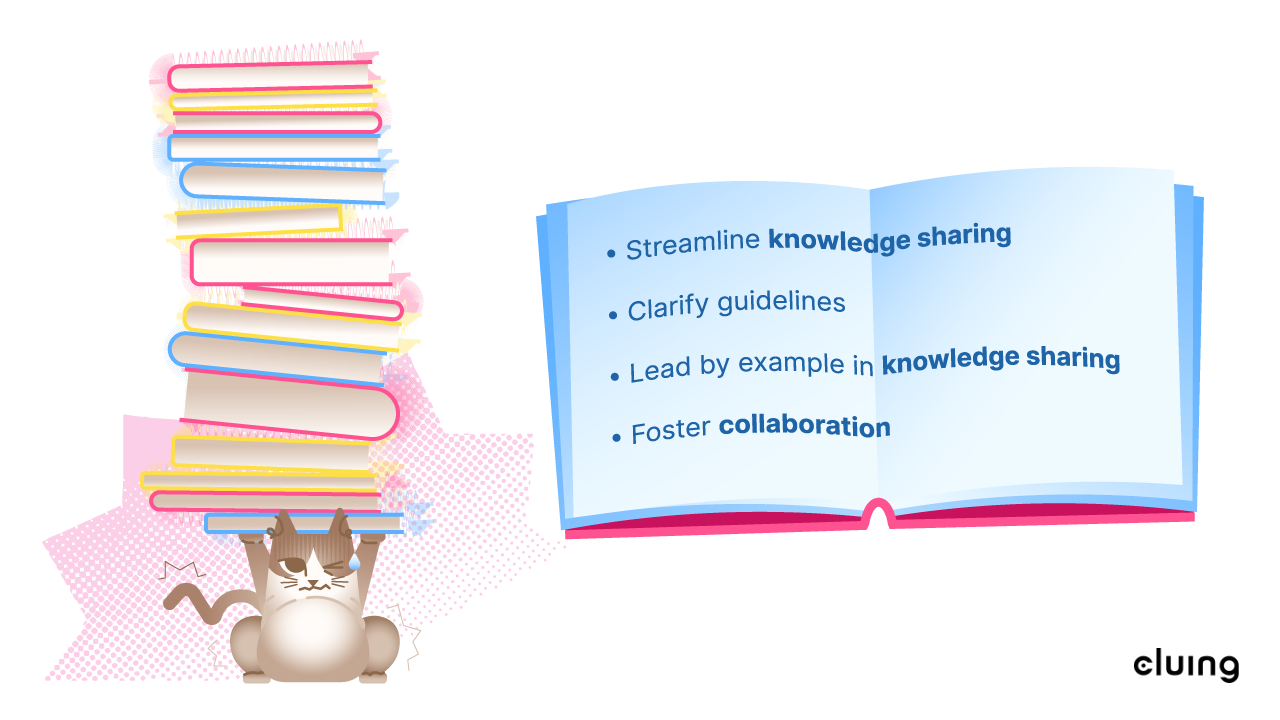
Putting an End to Knowledge Hoarding with the Right Tool
Simple acts like giving credit where it's due, rewarding excellence, and making it easy to share knowledge can help prevent employees from hoarding information.
However, lacking the right tools can also hinder knowledge sharing. Alongside changes to management style and workplace culture, consider using effective software.
Start by implementing a reliable knowledge-sharing tool since it's the first step towards a healthy and collaborative environment.
FAQ
What is knowledge hoarding?
Knowledge hoarding happens when someone keeps useful information to themselves instead of sharing it with others. It can also happen when a person collects knowledge but doesn’t consider that others might find it helpful too.
What is an information hoarder?
An information hoarder is someone who accumulates knowledge - research, processes, insights, or expertise — without passing it on to others who could benefit. In a workplace context, this often means keeping documentation private, not writing down processes, or avoiding knowledge transfer conversations.
Why do employees hoard knowledge?
Employees might hoard knowledge due to personal reasons like feeling more secure in their job, a lack of trust in the organization, fear of negative consequences, or a competitive workplace culture.
How does knowledge hoarding affect an organization?
Information hoarding creates knowledge silos, slows down productivity, increases the risk of knowledge loss when employees leave, frustrates teams dealing with knowledge gaps, and makes onboarding harder for new hires. Studies estimate it costs businesses $31.5 billion annually.
What can organizations do to prevent knowledge hoarding?
Organizations can prevent knowledge hoarding by building a centralized knowledge base, clarifying documentation guidelines, leading by example, incentivizing contribution, and redesigning rewards to recognize team outcomes not just individual performance.
How can a knowledge management platform help?
A knowledge management platform like Cluing reduces the friction that makes hoarding feel easier than sharing. When information is easy to find and easy to contribute, employees have less reason to keep it to themselves.
Originally published May 23, 2024. Updated for 2026.


![The Best Reddit Threads Disappear in a Week. Here's How to Keep Them [2026]](https://storage.ghost.io/c/9f/9d/9f9d32ee-55b4-4411-b435-9dc854e1751c/content/images/size/w600/format/webp/2026/06/reddit-cover.png)

![Read it later system for LinkedIn posts - Save, organize, and use what you find [2026]](https://storage.ghost.io/c/9f/9d/9f9d32ee-55b4-4411-b435-9dc854e1751c/content/images/size/w600/format/webp/2026/06/blog-3.png)


