


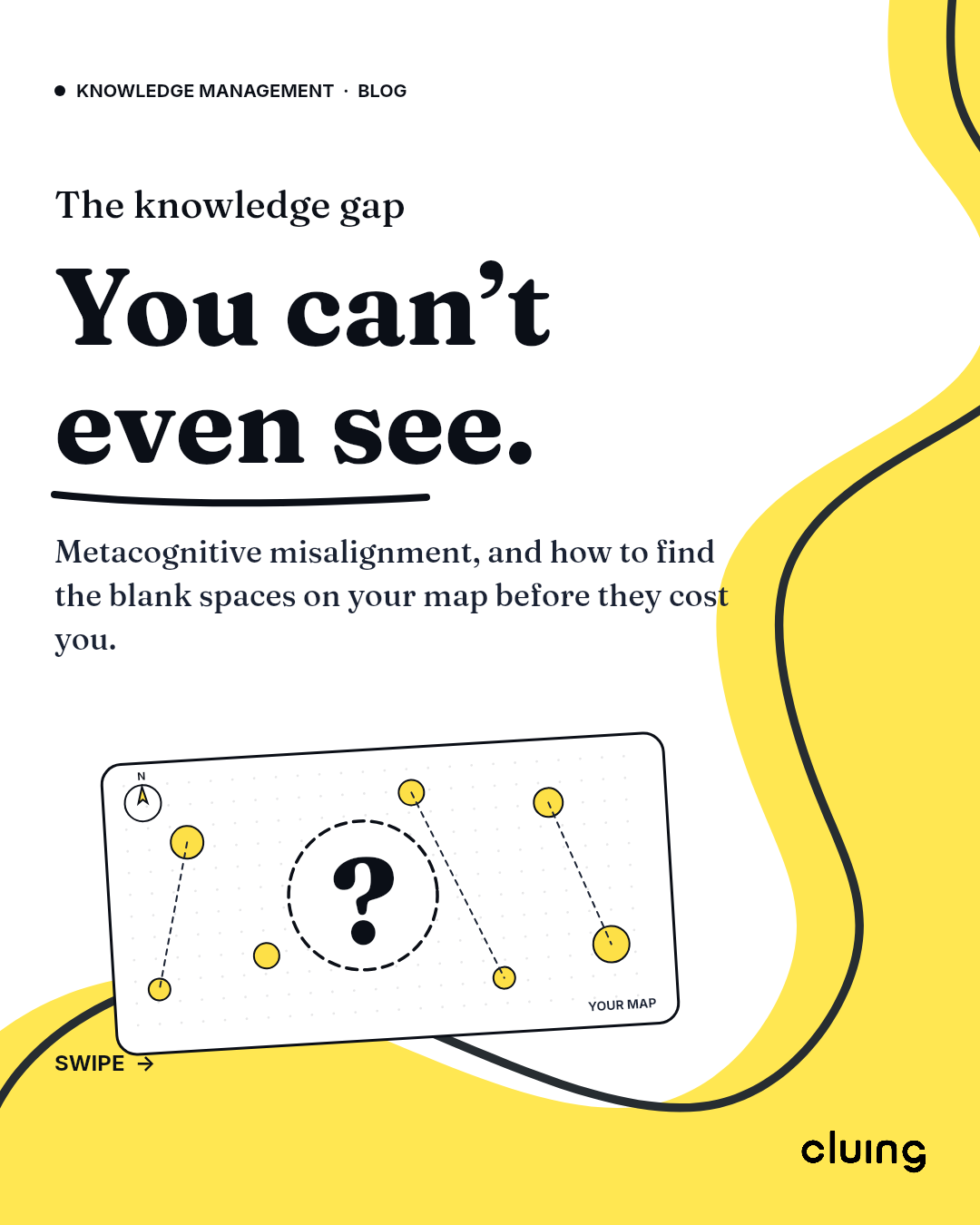
Most people don't even think about knowledge gaps. This blog describes why knowledge gaps don't have visible symptoms, how to find the symptoms, and what actions to take to fix the gaps.
This blog has previously explained metacognitive miscalibration, which is how you think you know something, but you really don't. However, there's a more serious problem that occurs before miscalibration.
What happens if you don't know there is a gap at all?
This is called metacognitive misalignment. This is more difficult to identify because it feels like you know rather than don't know.
Miscalibration vs. Misalignment - Why the Difference Matters
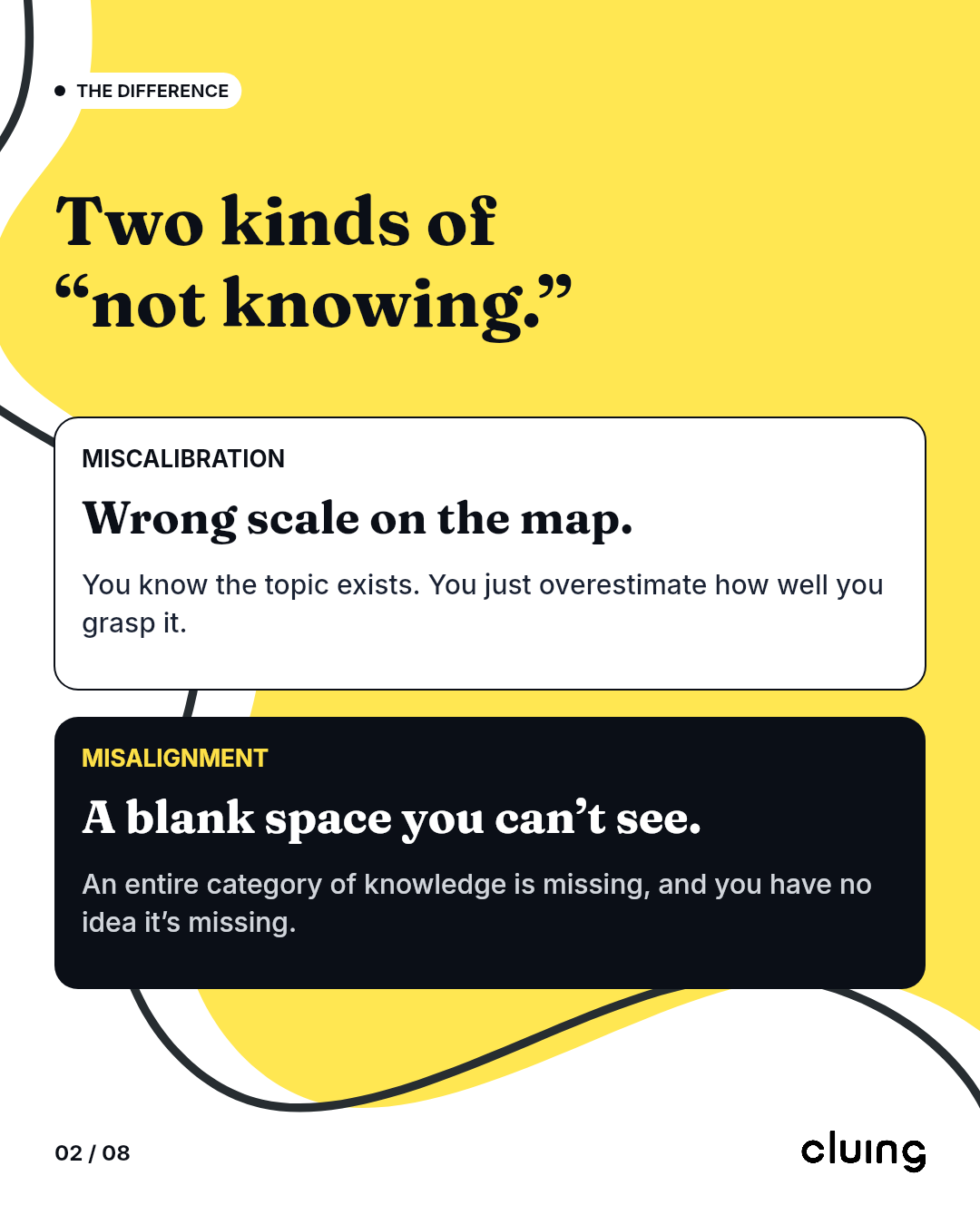
Miscalibration happens when there is a cost to having the wrong scale map. In this case, you have a blank map, but you don't know a space on your map is blank.
Misalignment is even more serious because a space on your map is blank, and you don't know that space is blank. There is an entire category of knowledge that you don't know about.
The Dunning-Kruger effect explains people who overestimate how confident they are, but what's more important is the valley that is "mount stupid". This valley is misalignment and occurs before people can even begin to have an idea about what they should be calibrating.
Miscalibration responds to slowing down, verifying, auditing. Misalignment requires something earlier: finding the gap before you can begin to measure it.
Why is it difficult to identify your own gaps in knowledge?
Knowledge gaps come with cruel, ironic, structural limitations. You can't search for something that you are unaware of. In addition to that, there are several external factors that can distort reality and make problems invisible.
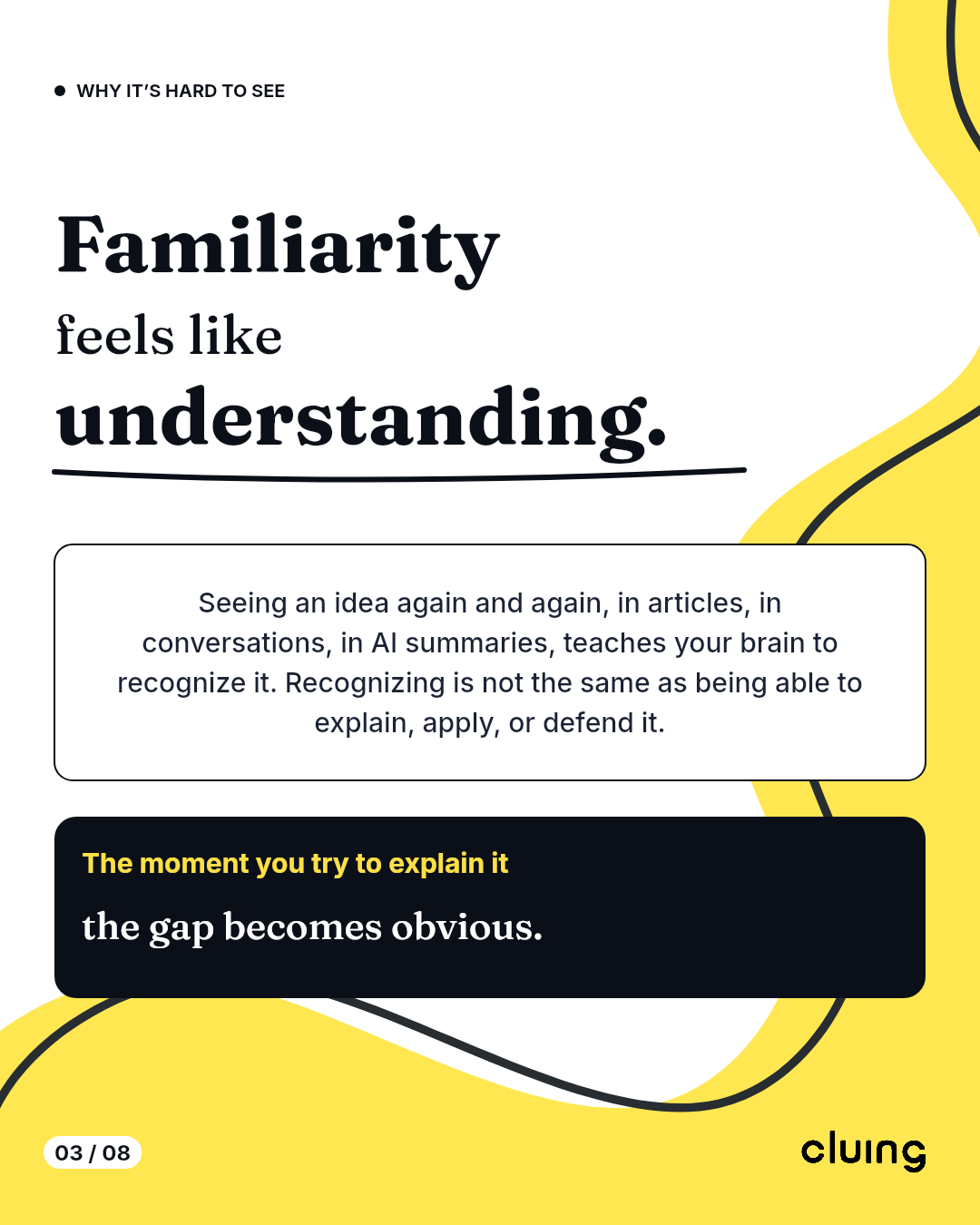
Being familiar with something can easily be mistaken for understanding it. If you are presented with an idea repeatedly, whether it be through articles, conversations, or AI summaries, you begin to recognize it.
The brain, unfortunately, like to equate the two, and so you can feel confident talking about something you have never discussed before, you have never worked through the idea to its first principles.
When you follow along with someone who has done the cognitive work, you may feel like you have a grasp of the idea. The problem is, you have no idea how to explain it yourself. The moment you try to explain it, the gap becomes all too clear.
This problem is made worse by the popular usage of AI. Large Language Models give you fluent, comprehensive answers. The answers they provide are so detailed that you feel that there is no reason to continue studying about the topic. What you have is a very detailed answer, but it is very surface level in the sense that there's a lot of missing information that you have no idea exists.
The more time you spend doing work in a field, the more you learn to rely on assumptions that were never checked.
Are You Mistaking Familiarity for Understanding?
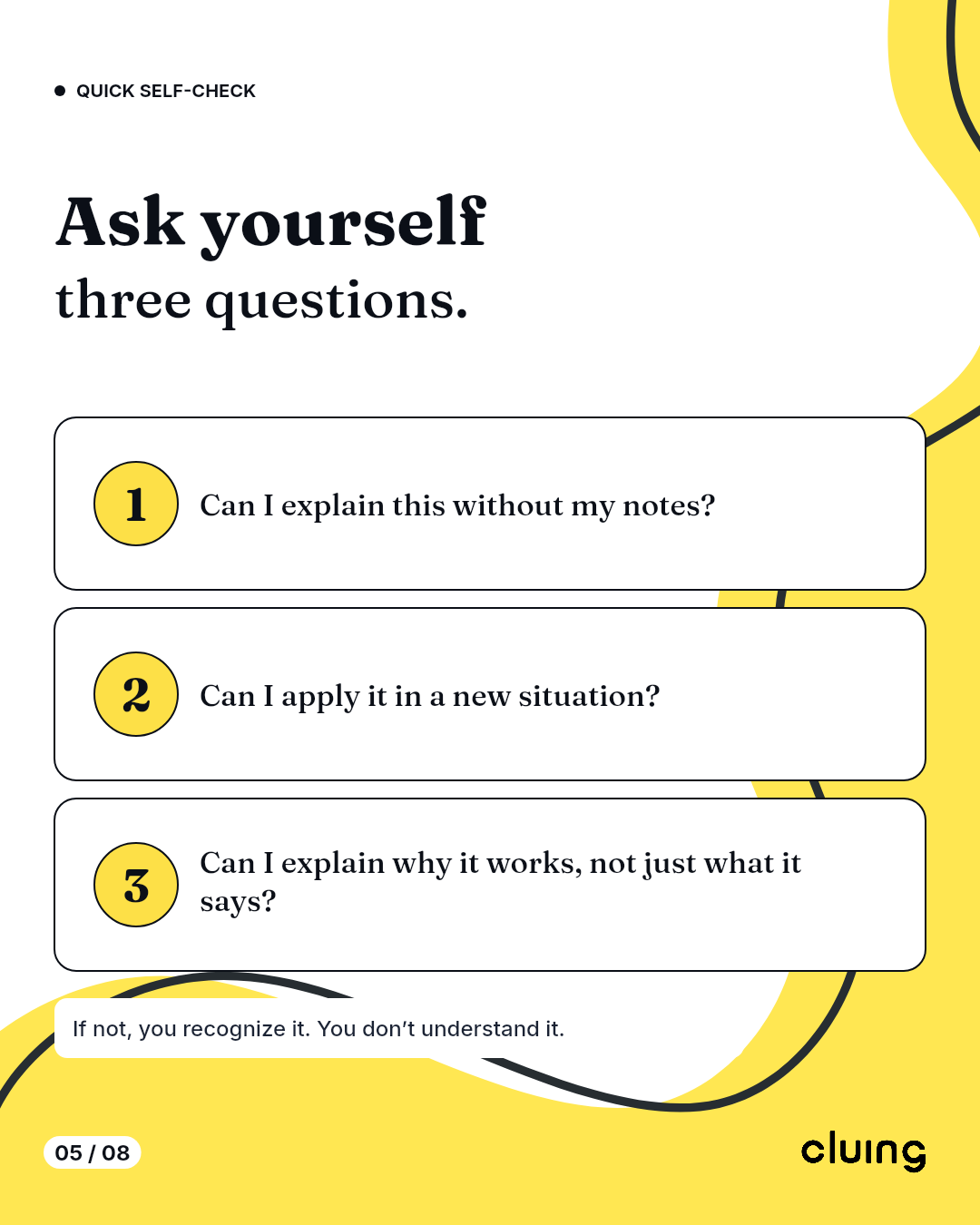
- Can I explain this idea without looking at my notes?
- Can I apply it in a new situation?
- Can I explain why it works, not just what it says?
If not, you might recognize the concept, but not fully understand it.
Signals That You Have a Knowledge Gap You Are Not Seeing
Misalignment is subtle. Usually, you'll have to read between the lines to notice it.
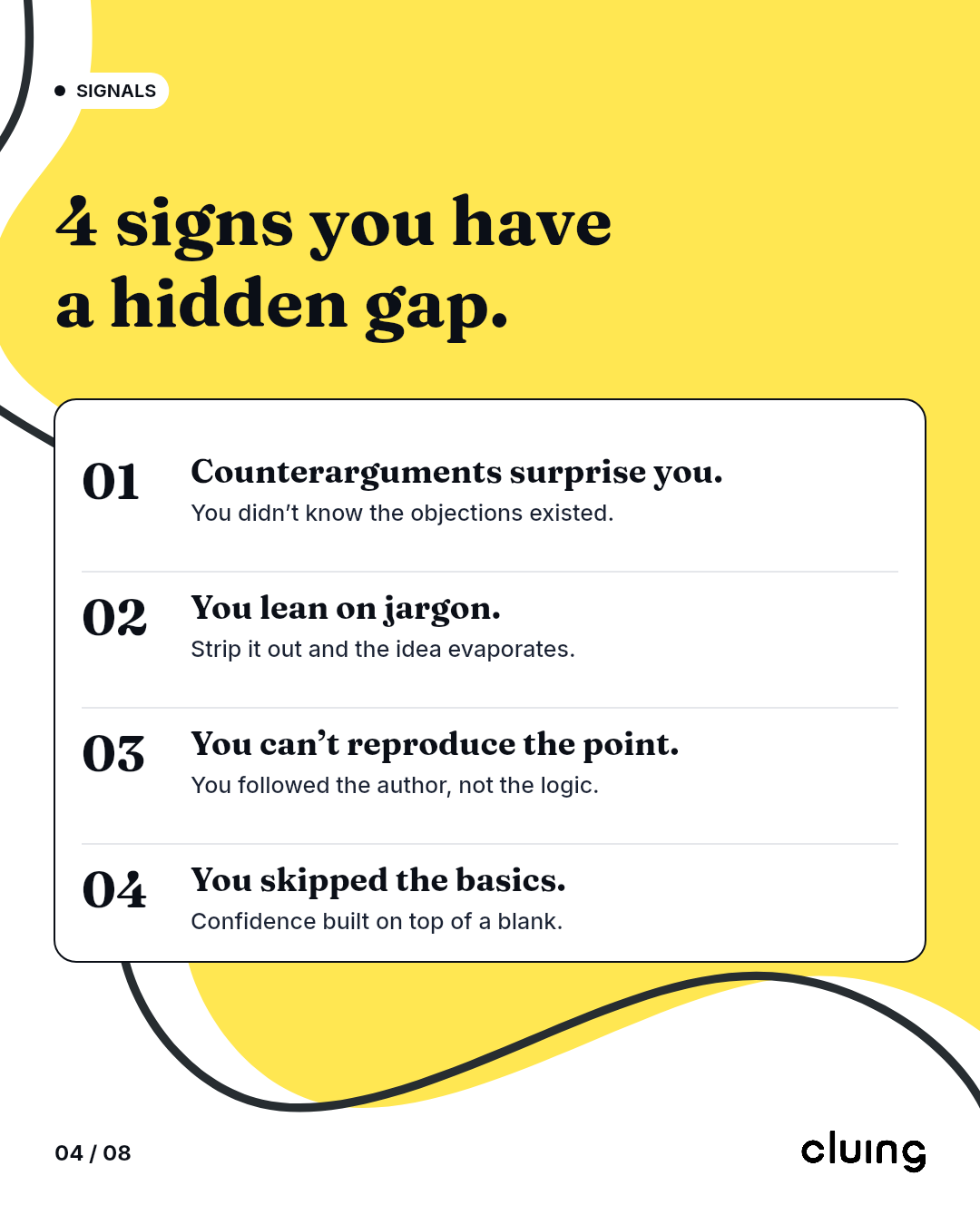
Counterarguments surprise you. Don't be impressed by the fact you have apathy about responding to counterarguments. Generally, if you have a full understanding of a concept, you will know what the objections to the idea are, and will reject them. The fact that you didn't know counterarguments means that they were not on your mental map.
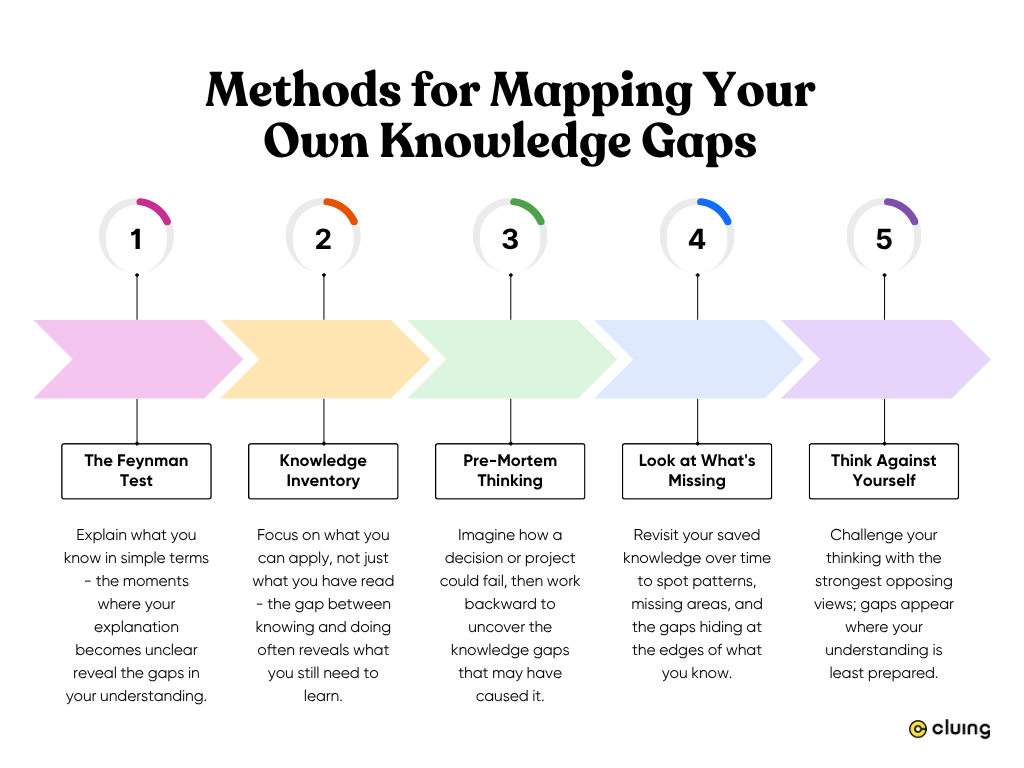
You cannot explain a concept without using technical jargon. The Feynman test is one of the easiest to understand. You should explain a concept to someone who has no idea about the concept. If you start to struggle and begin to use jargon, you are covering a knowledge gap and are not being precise.
You cannot reproduce your own comprehension. Sometimes, you read and feel a sense of understanding. When you try to summarize a concept and the key idea doesn't come to your mind or comes out stale, you didn't understand, you were following along the logic of the author.
You are confident you know the basics, so you skip the introductory material. When you skip the introductory material, you are creating the opposite of what you intended. You build gaps when you skip the basics.
"I'm confident that..." does not equate to what you actually understand. If you make a statement that you believe, but your only basis is walking around with a newsfeed and perpetuating snippets of information, you are lacking your own sustenance. You cannot create a foundation that you don't understand.
Mapping Your Knowledge Gaps: Techniques
Being aware of your knowledge gaps isn't something that you do once and forget about. Once you develop the habit, you will have a system that will help you identify the gaps.
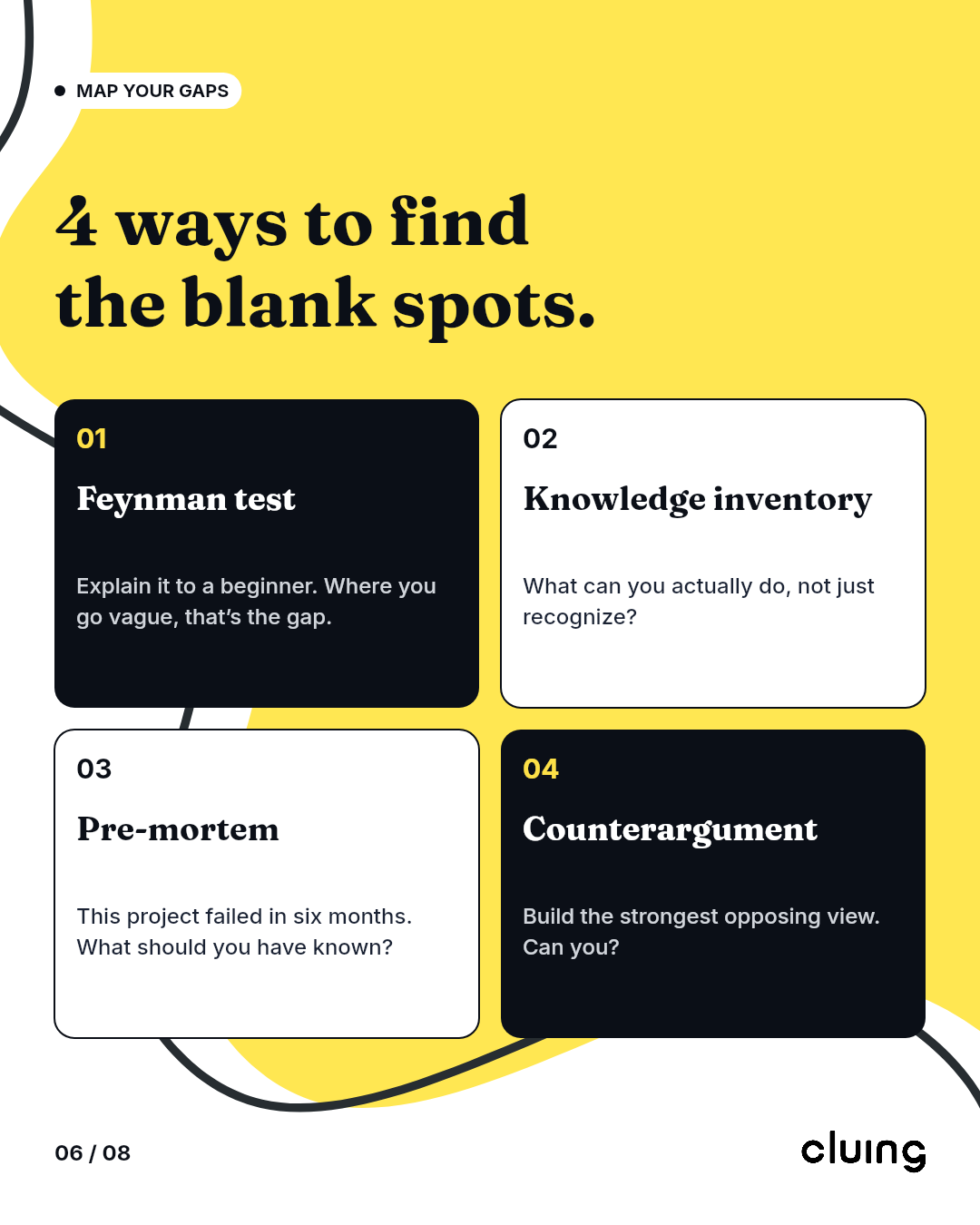
Feynman Test
Think of a topic that you are comfortable explaining. Imagine that you are explaining it to someone who knows nothing about it. What would your explanation look like? What would it sound like? What does your explanation look like where you have to be really vague? What does it look like when you avoid the topic/bypass your explanation? Those holes are your knowledge gaps.
Knowledge Inventory
What can you actually do? Not what can you do theoretically because you read about it. You might have the theoretical knowledge about the Frameworks of Thought, but you might not have the ability to apply it. You might not even have the ability to conduct the research that you learned about. The gap between what you know and what you can actually do is far greater than you can imagine.
Pre-Mortem Thinking
What do you imagine the failure of this decision or project six months later will look like? What do you think you should have known six months later to make this project successful? This thinking will help you identify the knowledge gaps that you are working with.
Saving and Revisiting Over Time (Look at What's Missing)
One of the unnoticed advantages to a building structured knowledge system occurs when you start to notice the gaps.
If you save related information and notice there are sections missing, it helps you to identify the boundaries of where your knowledge ends. The information you are continually skipping over, or the information you are saving but not responding to, identifies a knowledge gap.
Seek the Counterargument First
Before settling into a position, actively look for the strongest version of the opposing view - not to change your mind automatically, but to test whether your position can hold up against it.
If you find the counterargument genuinely surprising rather than merely wrong, you have found a gap. If you cannot even construct the counterargument yourself, the gap is larger than you thought.
Two Kinds of Knowledge Gaps and Why They Require Different Fixes
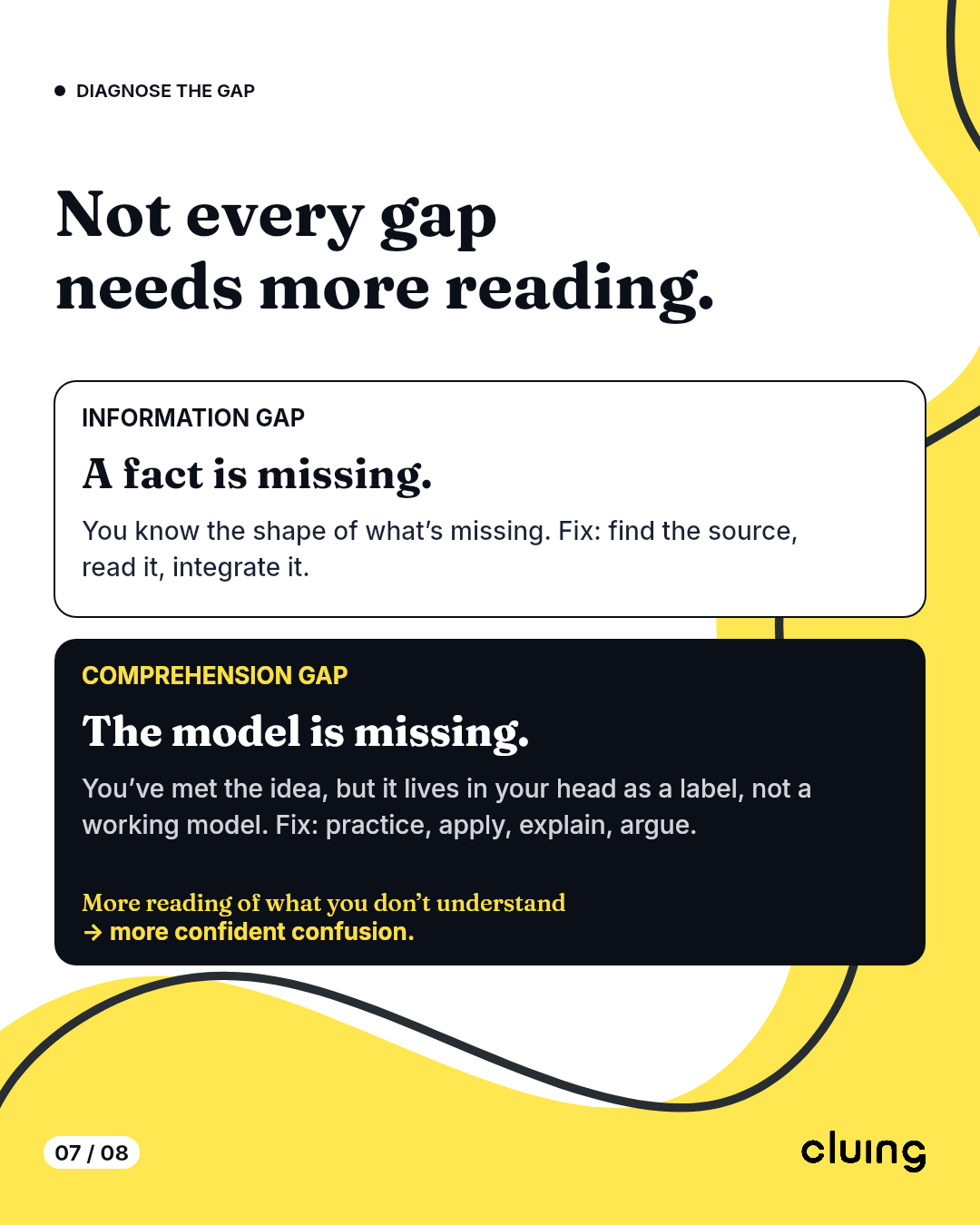
There are different types of knowledge gaps, and if they are all assumed to be the same, the horrible mistakes are made because they are not the same.
1) An information gap means you are missing a fact, a study, a piece of data, or a source. You know the shape of what you are missing. The fix is straightforward: find the right source, read it, verify it, integrate it. This is where research tools, databases, and well-curated knowledge bases do most of their work.
2) A comprehension gap is different. You have encountered the information - possibly multiple times - but you have not built a working understanding of it. The concepts are in your head as labels, not as working models. You can repeat the idea but not apply it, not defend it, not extend it. The fix here is not more reading. It's practice, application, explanation, and conversation. It requires engaging with the material in a way that produces friction, because friction is how comprehension is built.
Most people treat comprehension gaps as information gaps. They go and read more. More reading of a thing you do not understand tends to produce more confident confusion, not clarity. Recognizing which kind of gap you are dealing with is the first step toward actually closing it.
The Role of Your Knowledge System in Making Gaps Visible
A knowledge system is not just storage. At its best, it is a mirror, a way of seeing the shape of what you actually know, rather than what you think you know.
When you externalize your understanding by saving insights, writing notes, tagging ideas, and revisiting them over time, you make your knowledge structure inspectable. You can look at it from the outside. And from the outside, the gaps are much easier to see.
This is why passive consumption (reading without capturing, listening without noting, browsing without saving) does so little for actual learning. It leaves no record. It creates the feeling of knowing without the substance of it. And it gives you nothing to look back at when you want to ask: what do I actually understand here, and where are the holes?
The Bottom Line
Metacognitive misalignment is the default state for anyone who consumes more than they examine. In an environment where AI tools produce fluent, complete-looking answers at scale, it is becoming more common.
The good news is that the gap itself is not the problem. Every expert has gaps, at every level of knowledge. What creates the risk is not seeing them.
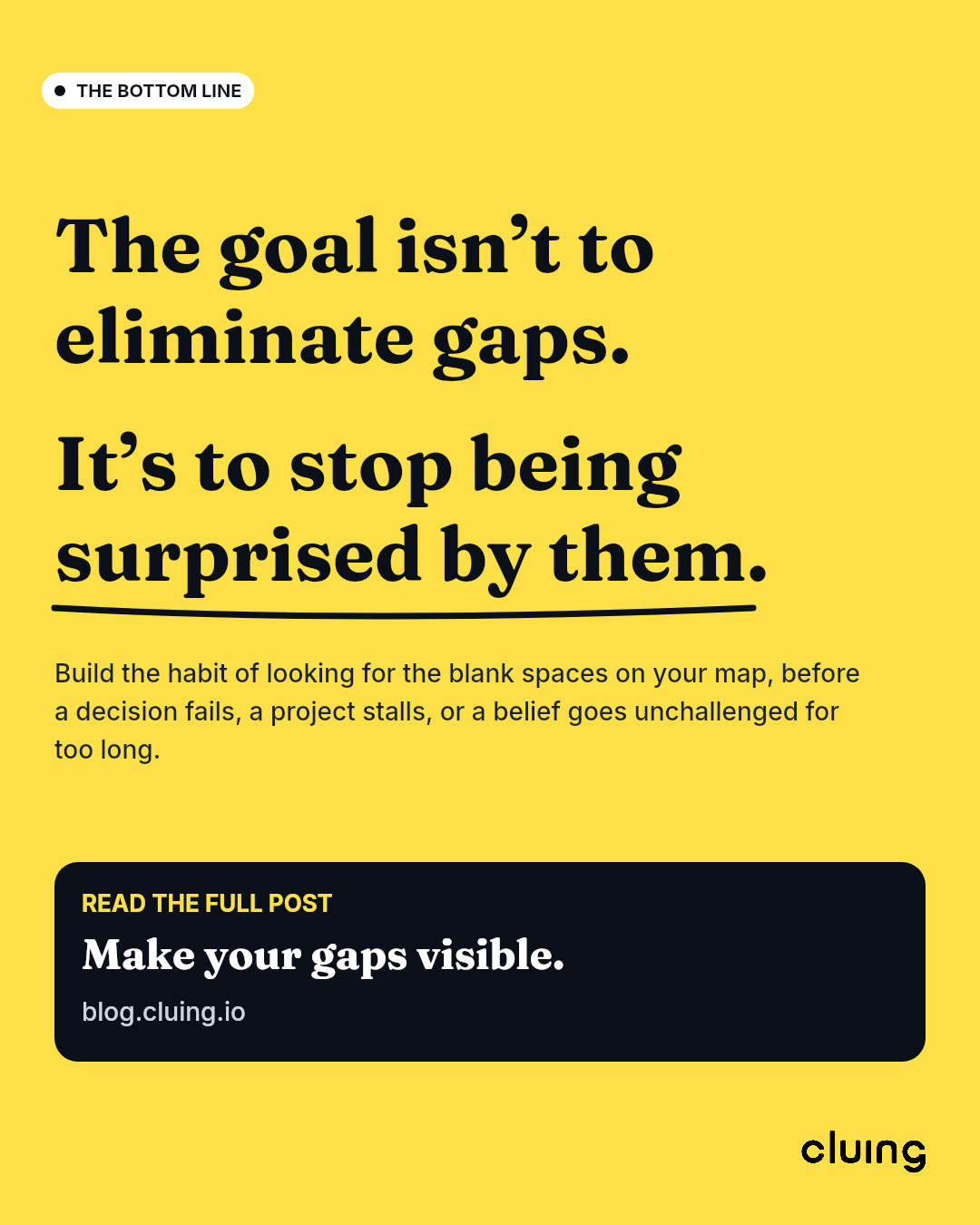
And the goal isn't to eliminate your knowledge gaps. It's to stop being surprised by them. To build the habit of looking for the blank spaces on your map before they become the reason a decision fails, a project stalls, or a belief goes unchallenged for longer than it should.
If you want to move beyond identifying gaps to calibrating how accurately you assess what you do know, read our piece on Metacognitive Miscalibration — Moving Beyond "I Think I Know".
And if you want a system that makes your knowledge structure visible - so the gaps become easier to find - Cluing is a place to start.
FAQ 🧐
What is metacognitive misalignment?
Metacognitive misalignment is when you are unaware that a knowledge gap exists at all - not just when you misjudge how well you know something, but when you have no sense that something is missing from your understanding in the first place.
How is metacognitive misalignment different from metacognitive miscalibration?
Miscalibration means you know a topic exists but overestimate your grasp on it. Misalignment goes deeper - you do not have the gap on your radar at all. Miscalibration is a faulty measurement; misalignment is a missing measurement.
Why is it so hard to see your own knowledge gaps?
Because familiarity feels like understanding, fluent explanations create a false sense of comprehension, and AI tools now produce complete-sounding answers that hide where real knowledge ends. The gap is invisible by nature.
What is the fastest way to find a knowledge gap?
Try to explain the concept in plain language without using technical terms. Where your explanation becomes vague or circular, the gap is. This is the core of the Feynman test.
What is the difference between an information gap and a comprehension gap?
An information gap means a fact or source is missing. A comprehension gap means you have encountered the material but have not built a working understanding of it. The first is fixed by research; the second is fixed by practice and application.
How does a knowledge management system help with knowledge gaps?
By externalizing your understanding, you make your knowledge structure visible. The blank spaces become apparent in a way they never are when knowledge stays inside your head.


![The Best Reddit Threads Disappear in a Week. Here's How to Keep Them [2026]](https://storage.ghost.io/c/9f/9d/9f9d32ee-55b4-4411-b435-9dc854e1751c/content/images/size/w600/format/webp/2026/06/reddit-cover.png)

![Read it later system for LinkedIn posts - Save, organize, and use what you find [2026]](https://storage.ghost.io/c/9f/9d/9f9d32ee-55b4-4411-b435-9dc854e1751c/content/images/size/w600/format/webp/2026/06/blog-3.png)


![Cognitive Capital - The New Layer of Value [2026]](https://storage.ghost.io/c/9f/9d/9f9d32ee-55b4-4411-b435-9dc854e1751c/content/images/size/w600/format/webp/2026/05/covers--9-.png)