



For centuries, wealth meant owning things. Land, machines, resources. That era didn't slowly fade - it was disrupted overnight. And most people still haven't noticed.
Ask someone what makes a country rich, and they'll probably mention natural resources, manufacturing output, or trade. These answers aren't wrong - they're just outdated. The engine of modern prosperity has shifted to something far less tangible and far more powerful: the organized output of human thinking.
Welcome to the brain economy. Not a future scenario, not an economist's abstraction - a present reality that is already determining which individuals, companies, and nations pull ahead, and which ones quietly fall behind while still playing by yesterday's rules.
A brain economy puts the brain at the center of the economy. It designs the economy, society, and organizations with the brain in mind. And that is super important now that we are changing the whole architecture of how we work, with agents, robots, and super AI. - Source: McKinsey
1. Cognitive capital has quietly become the world's most valuable asset
Here's a thought experiment.
Two businesses opened in the same year. One builds a factory producing car parts. The other hires a small team to write software. Within a decade, the software company will likely employ more people, generate more revenue per employee, and expand globally, all without ever building a second facility. The factory, meanwhile, is facing automation pressure and shrinking margins.
This isn't hypothetical. It's the story of the past 30 years, playing out in economy after economy. The shift isn't just about which industries are growing; it's about what kind of work creates lasting value. Routine tasks, whether physical or cognitive, are increasingly handled by machines. What remains irreplaceable, and therefore increasingly valuable, is judgment, creativity, and the ability to navigate complexity.
The most dangerous economic gap today isn't between those who own property - it's between those who generate original thinking and those who execute someone else's instructions.
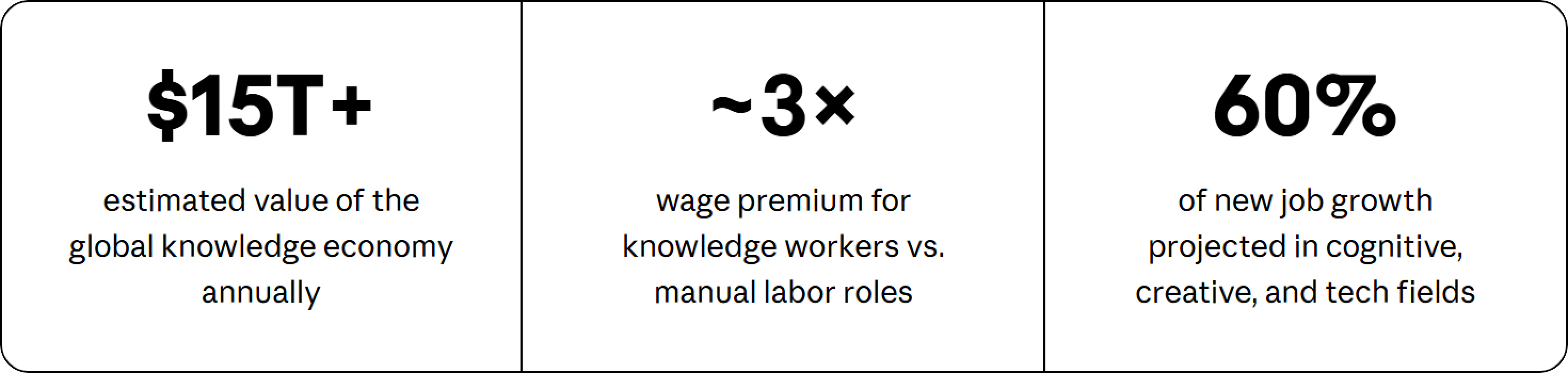
US knowledge workers alone account for an estimated $10–11 trillion in annual compensation - roughly 40–45% of the entire US economy. And within that group, the premium for advanced cognitive skills is accelerating: roles specializing in AI and machine learning command 30–50% higher pay than comparable positions that don't require those skills.
2. The economics of ideas break every rule we learned in school
Traditional economics taught us about scarcity: you can only sell a barrel of oil once. Ideas don't work that way. A piece of software, once written, can serve a million users or a billion - the incremental cost of each new user approaches zero. This single fact rewrites the economics of nearly every industry it touches.
It explains why companies like Google and Meta, which manufacture nothing physical, command market valuations that dwarf traditional industrial giants. It explains why a two-person startup can outcompete a century-old corporation. And it explains the uncomfortable winner-takes-all dynamics that define so many modern markets: when the best product costs nothing extra to copy, why would anyone settle for second best?
For workers, this creates a profound challenge. If your contribution to an organization is something a sufficiently sophisticated algorithm could replicate (processing data, following scripts, applying known rules), your position in the brain economy is fragile. The WEF's 2025 Future of Jobs Report found that 39% of workers' core skill sets will need to transform by 2030, with the steepest declines in roles involving routine cognitive tasks: data entry, administrative processing, and basic legal research.
"A single algorithm, deployed at scale, can make a decade of manual work obsolete by Thursday afternoon. The question is whether you're writing the algorithm or being replaced by it."
But the same report projects a net gain of 78 million jobs globally by 2030 because the brain economy doesn't just destroy work, it creates new categories of it. The fastest-growing roles in percentage terms are big data specialists, fintech engineers, and AI and machine learning specialists. The skill common to all of them: the ability to work with, direct, and improve thinking machines.
 Gordana Laskovic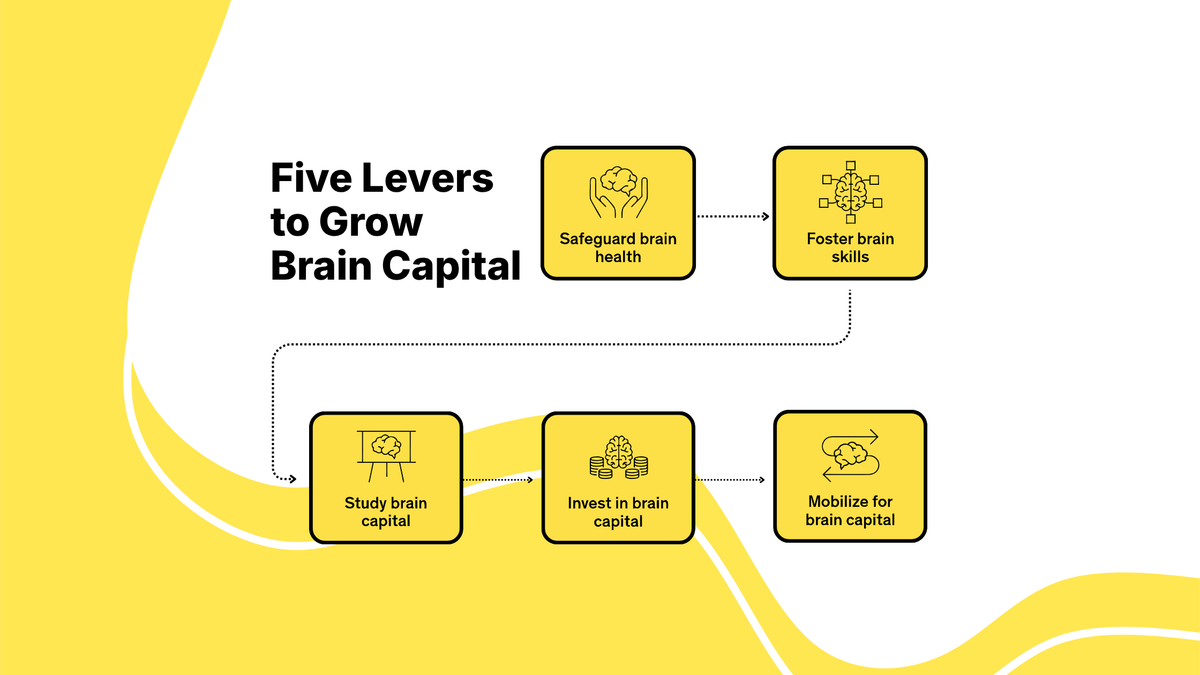
3. The talent race has become the defining geopolitical contest of our era
In the industrial age, nations competed over iron, coal, and oil. In the brain economy, the competition is over people, specifically, the relatively small share of people capable of generating disproportionate economic value through their cognitive output.
This competition still has a geographic dimension, but it's shifted.
The great knowledge clusters such as Silicon Valley, London, Singapore, and Seoul didn't emerge by accident. They exist because innovation is, paradoxically, social.
The density of smart, motivated people in close proximity creates something that can't be replicated remotely: the accidental conversation, the cross-pollination of ideas between disciplines, the informal networks that turn one good insight into a funded company.
And yet the pandemic cracked the old geography open. For the first time, a developer in Novi Sad or a designer in Nairobi can work for a San Francisco company at San Francisco compensation levels. This geographic arbitrage is slowly redistributing economic energy and creating a new kind of competition between cities and countries for the talent that drives it.
The WEF identifies broadening digital access as the single most transformative trend shaping labor markets through 2030, with 60% of employers expecting it to reshape their business.
Nations that invest seriously in education quality, research infrastructure, political stability, and livability will accumulate cognitive capital. Those that don't will export it - a dynamic economist calls brain drain, and that every ambitious government should treat as an economic emergency.
So what does any of this mean for you?
Most conversations about the brain economy stay comfortably abstract. Here's the uncomfortable version: the brain economy doesn't reward effort. It doesn't care how many hours you logged or how loyal you've been. It rewards leverage, the capacity to make your thinking work at a scale beyond your direct involvement.
The brain economy rewards leveraged thinking more than raw effort.
That might mean writing, teaching, building systems, or creating tools that others use. It might mean developing deep enough expertise in a narrow area that you become genuinely irreplaceable rather than broadly competent and easily substituted.
The WEF's skills outlook flags analytical thinking, creative problem-solving, and AI literacy as the top capabilities employers will prioritize through 2030 - not because these are trendy, but because they are the hardest to automate.
The goal isn't to work harder inside the old system - it's to understand that the system itself has changed.
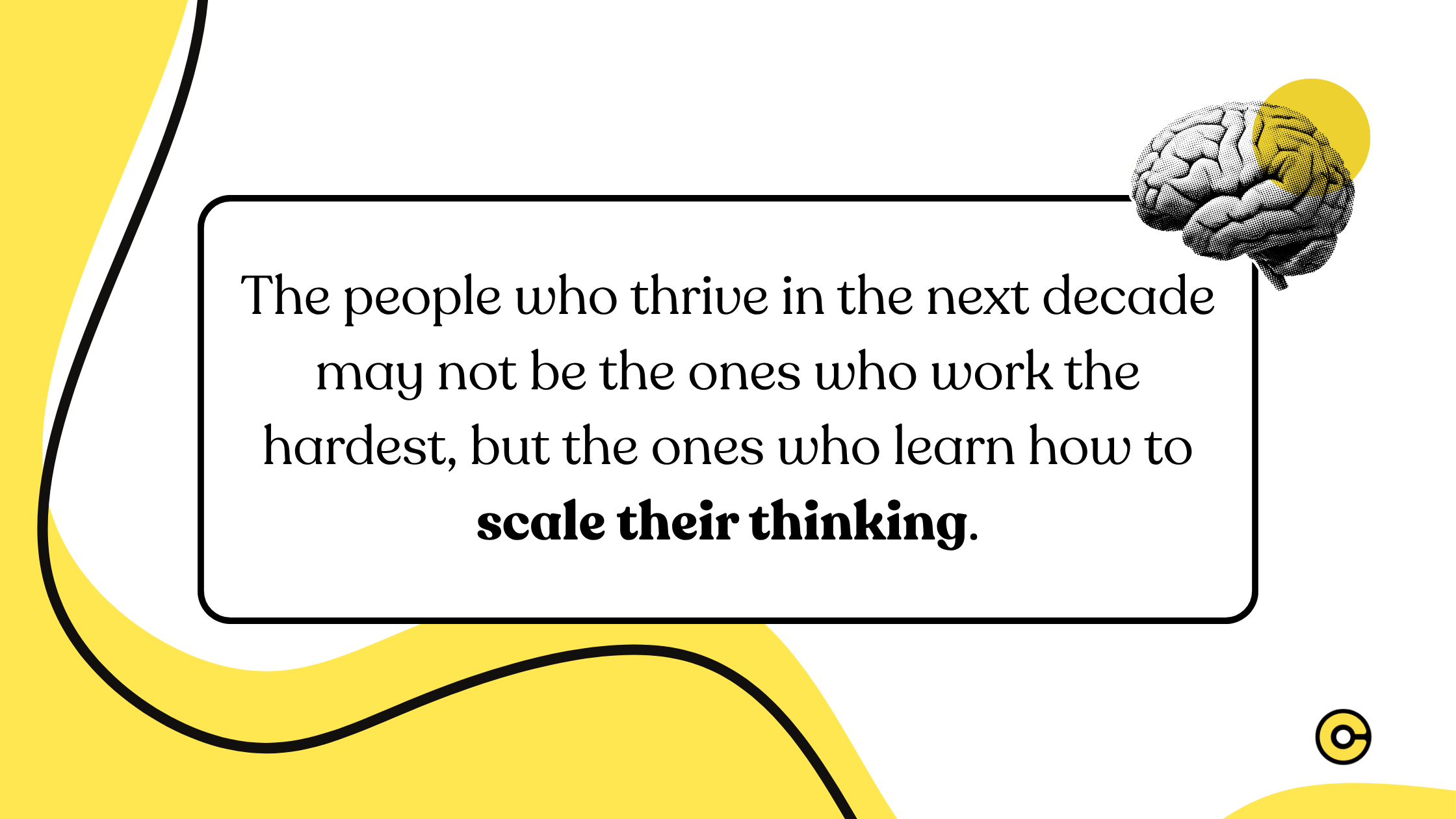
The brain economy isn't an opportunity available only to the elite. But it does demand a deliberate shift in how you think about your own value, away from time invested, and toward the reach and durability of what your thinking produces.
That shift starts with recognizing that the economy already made the switch. The only question is whether you have.
If you want to dig deeper, here are a few useful reads.
FAQs 🧐
What is the brain economy?
An economic system where human thinking - creativity, judgment, and expertise - is the primary source of value, replacing physical resources and manufacturing as the engine of prosperity.
How does the brain economy differ from the industrial economy?
Industrial wealth came from owning physical assets - factories, land, resources. The brain economy runs on ideas, which can scale to millions of users at near-zero cost. That changes who wins and why.
What jobs are most at risk in the brain economy?
Roles built on routine cognitive tasks: data entry, administrative processing, and basic legal research. The WEF estimates 39% of workers' core skill sets will need to transform by 2030.
What skills are most valuable in the brain economy?
Analytical thinking, creative problem-solving, and AI literacy - skills that are hardest to automate. The WEF flags these as the top employer priorities through 2030.
Will the brain economy destroy more jobs than it creates?
No. The WEF projects a net gain of 78 million jobs globally by 2030. New roles in AI, data science, and fintech are growing faster than routine roles are disappearing.
How can I thrive in the brain economy?
Focus on leverage - making your thinking work at scale through writing, teaching, building systems, or deep expertise. The brain economy rewards the reach of what you produce, not the hours you log.
How big is the brain economy in the US?
US knowledge workers account for an estimated $10–11 trillion in annual compensation — roughly 40–45% of the entire US economy. AI and ML roles command 30–50% higher pay than comparable positions.


![The Best Reddit Threads Disappear in a Week. Here's How to Keep Them [2026]](https://storage.ghost.io/c/9f/9d/9f9d32ee-55b4-4411-b435-9dc854e1751c/content/images/size/w600/format/webp/2026/06/reddit-cover.png)

![Read it later system for LinkedIn posts - Save, organize, and use what you find [2026]](https://storage.ghost.io/c/9f/9d/9f9d32ee-55b4-4411-b435-9dc854e1751c/content/images/size/w600/format/webp/2026/06/blog-3.png)


![Cognitive Capital - The New Layer of Value [2026]](https://storage.ghost.io/c/9f/9d/9f9d32ee-55b4-4411-b435-9dc854e1751c/content/images/size/w600/format/webp/2026/05/covers--9-.png)