



Everyone Has Data. Not Everyone Has Insight.
Open any industry report. Scroll through LinkedIn. Sit in a quarterly business review. You'll find the same thing everywhere: data, data, and more data. Charts. Percentages. Trend lines pointing up and to the right.
And yet, most of it is forgettable.
Here's why: data without interpretation is just noise. What separates a high-performing professional from the rest of the crowd isn't access to information - it's the ability to extract unique insight from that information. The kind of insight that makes someone in a meeting lean forward and say, "Wait, I hadn't thought of it that way."
That's a competitive advantage. And it's more achievable than you think.
What Is a "Unique Insight" Exactly?
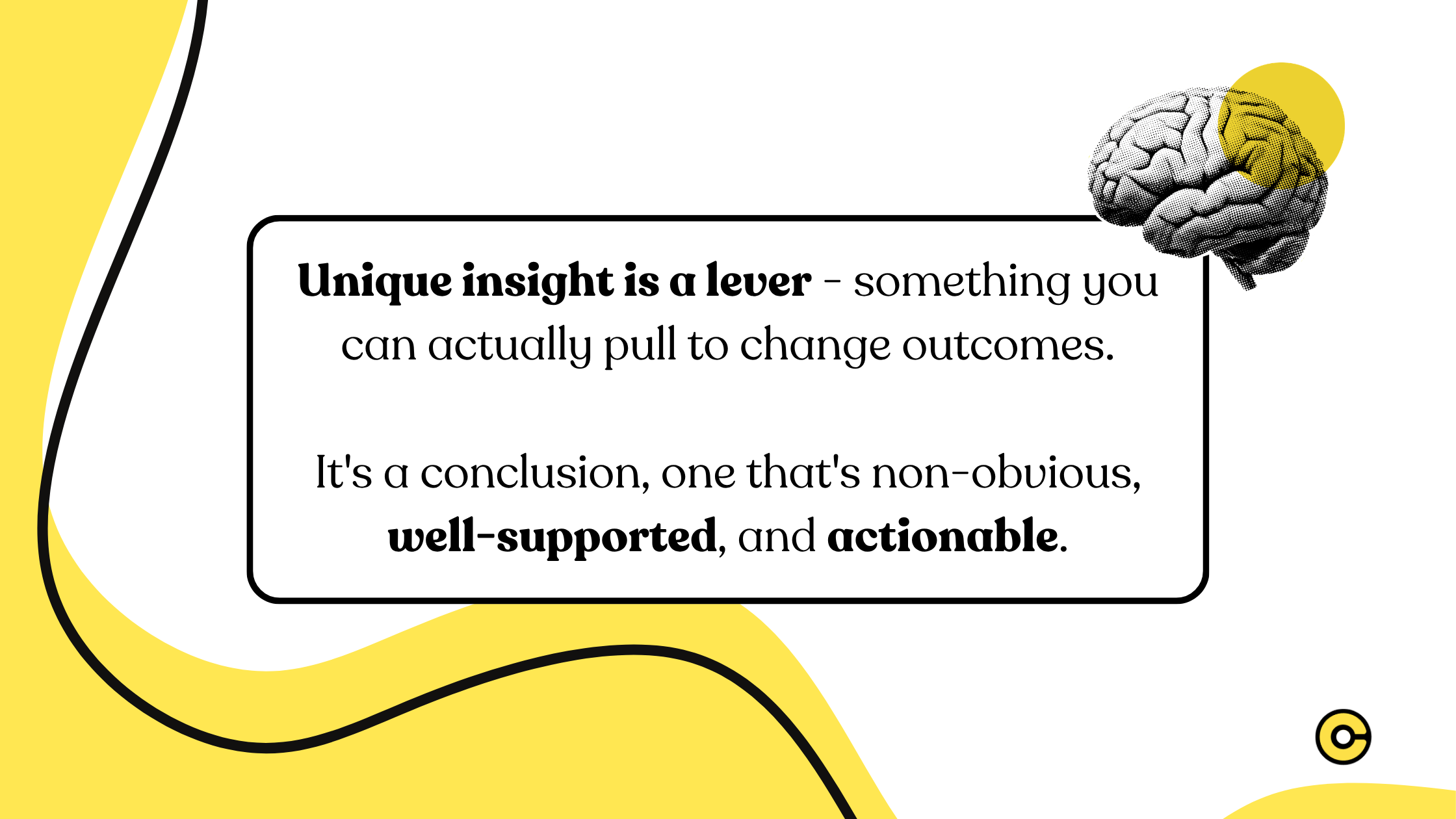
A unique insight isn't a fun fact or a surprising statistic. It's a conclusion, one that's non-obvious, well-supported, and actionable.
Think of it this way:
- Data point: Customer churn increased by 12% last quarter.
- Observation: Churn spiked among users who didn't complete onboarding.
- Unique insight: Users who skip the onboarding tutorial are 3x more likely to churn within 30 days, and a single targeted email at day 7 reduces that risk by 40%.
See the difference? The data point is a signal. The observation is a pattern. The insight is a lever - something you can actually pull to change outcomes.
Unique insights tend to share a few qualities:
- They challenge a common assumption or reframe a familiar problem
- They're backed by evidence (data, research, direct experience)
- They point toward a specific action or decision
- They're not already obvious to everyone in the room
Why Unique Insights Are a Competitive Advantage - Especially in 2026
In virtually every profession, the people who advance fastest are those who consistently bring something others don't. Not just hard work. Perspective.
That was true ten years ago. In 2026, the dynamic has shifted in a way that makes perspective even more valuable.
Everyone has AI now. Competitors can generate a market analysis, summarize a 50-page report, or produce a first-draft strategy deck in minutes. The tools are the same. The access is the same. The speed is the same. A competitive edge built on "I can research faster and synthesize better" has largely disappeared. AI closed that gap.
What AI cannot do, at least not yet, is replace the judgment that comes from living inside an industry, building real relationships, making calls that turned out wrong, and developing the pattern recognition that only comes from years of paying close attention.
AI can hand you the map. Reading the actual terrain is still a human job.
There's another layer to this worth understanding. AI has raised the floor of insight quality across the board.
The average professional today has access to better research, summarization, and synthesis tools than the best-resourced analysts did a decade ago.
Surface-level insight, the kind that amounts to well-packaged information, no longer impresses anyone. People expect it. The bar for what qualifies as a unique insight has moved up considerably, and that's precisely where the opportunity opens up.
AI works best as a research assistant. Feed it a question, and it will pull data, flag contradictions, surface patterns, and save hours of manual work. The important thing to understand, though, is that the insight doesn't live in the research output. The insight lives in what happens next, in the interpretation, the gut check, the moment where something in the data conflicts with what a customer told you last week, the connection no AI was in the room to make.
Professionals winning right now are those who use AI to accelerate the information-gathering phase, then apply their own verified, experience-backed perspective to make sense of what they found. They do more research than before, faster, and then go deeper on the layer of interpretation that AI cannot reach.
A large-scale study published in HBR in August 2025 - Soft Skills Matter Now More Than Ever - analyzed over 70 million job transitions across more than 1,000 occupations and found that people with a broad base of foundational skills, including critical thinking and problem-solving, consistently learned faster, earned more, and advanced further than those with narrow technical specialization.
 Gordana Laskovic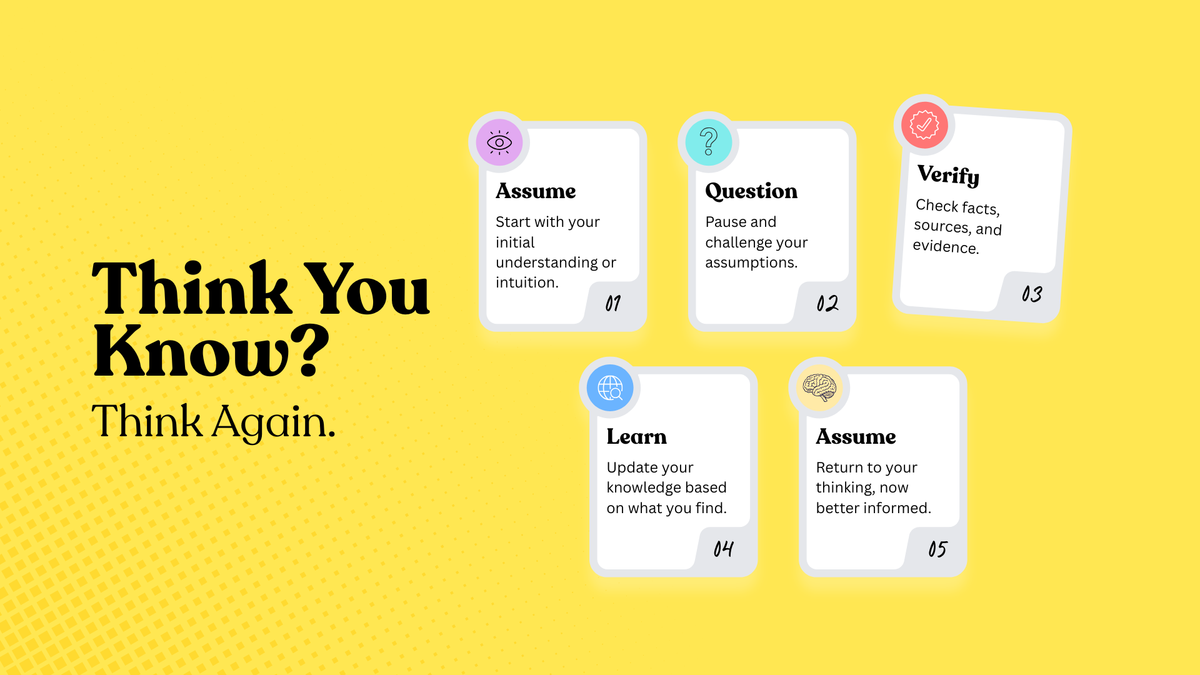
As AI handles more of the execution layer, the professionals who advance are those operating one level above: asking better questions, challenging flawed assumptions, and understanding what data actually means in context.
The same dynamic plays out in sales. Challenger's own 2025 Selling Challenges Research confirms that the core principle from the original Challenger Sale still holds: sellers who deliver unique, tailored insight dramatically outperform those who lead with product features.
The stakes are higher now, because buyers arrive further along in the process, having already done their own research online. What a chatbot cannot provide is a genuine, experience-backed read on their specific situation.
In marketing, original research and proprietary insight compound over time. According to Content Marketing Institute's 2024 data, original research and data studies earn 4.3x more backlinks than opinion-based content, precisely because they offer something genuinely new rather than a repackaging of what already exists. Backlinko's own 2026 content marketing guide doubles down on this, noting that original data has become more valuable than ever as AI-generated content floods the internet.
The pattern holds across strategy, consulting, investing, product development, and creative fields. In 2026, "grounded" is the operative word. Ungrounded takes are cheaper to produce than ever. Information has become abundant to the point of noise. What remains scarce, and therefore valuable, is verified, experienced, human perspective sitting on top of that information.
That gap between what AI produces and what a sharp human mind does with it? That gap is the competitive advantage.
Where Unique Insights Actually Come From
This is where most people get stuck. They assume insight requires genius, or access to expensive data tools, or years of specialized experience. It doesn't - at least not always.
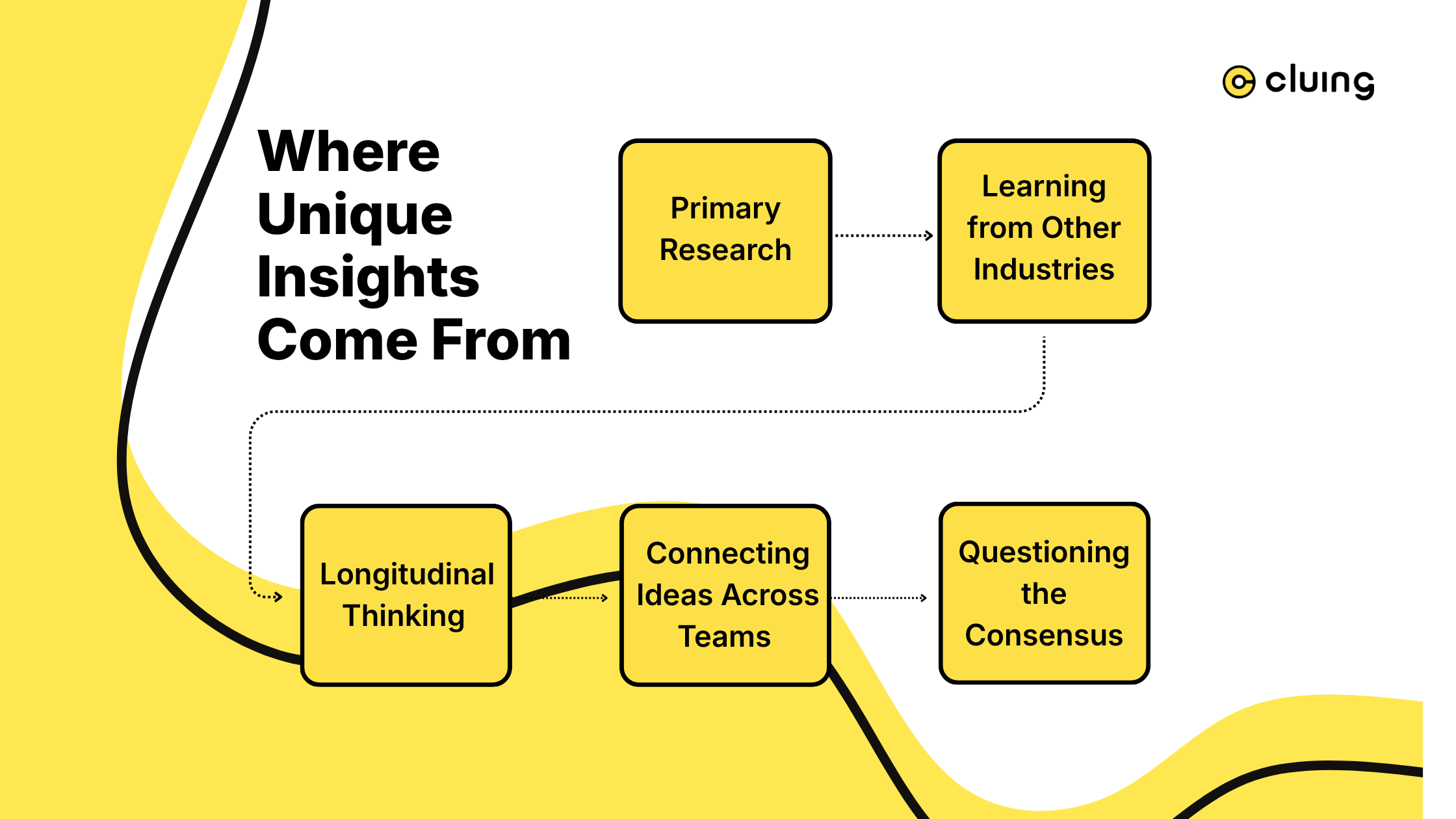
Here are the most reliable sources of unique insight that professionals across industries are using right now.
1. Primary Research (Even Small-Scale)
Most people rely entirely on secondary research - published reports, industry articles, other people's surveys. When you do your own research, even at a small scale, you immediately have something no one else does.
This could mean:
- Conducting 10 in-depth customer interviews rather than relying on a survey
- Running a quick poll in your professional community
- Analyzing your own company's internal data in a way no one has before
The insight doesn't have to come from a massive dataset. It has to come from your dataset. A finding from 50 real conversations can be more compelling than a stat from a report 10,000 people have already read.
2. Cross-Industry Pattern Recognition
Some of the most powerful insights come from looking sideways - borrowing a framework or pattern from one industry and applying it to another.
Amazon's obsession with the "working backwards" method (start from the press release, work back to the product) was borrowed from industrial design thinking.
Netflix's recommendation engine drew from collaborative filtering techniques that originated in academic research - specifically the GroupLens project at the University of Minnesota in 1994, not in entertainment. The people who spotted these cross-domain patterns and applied them early had enormous advantages.
Ask yourself regularly: What's working brilliantly in an adjacent industry that no one in mine is talking about?
3. Longitudinal Thinking
Most professionals are optimized for the present. They read last week's newsletter, react to this quarter's numbers, and plan for the next 90 days. This creates a massive gap for anyone willing to think in longer arcs.
Longitudinal insight means tracking something over time that others have stopped paying attention to - a slow-moving trend, a metric that's been gradually shifting, a behavioral pattern that's been building for years. When that trend finally breaks into the mainstream, you're already three steps ahead.
4. Connecting Dots Across Silos
Organizations are full of information that never crosses departmental lines.
The sales team knows something the product team doesn't. The customer success team is sitting on feedback that marketing has never heard. The finance team sees a pattern in the numbers that operations hasn't noticed.
If you're someone who operates across functions, or even just talks to people across functions, you're in a position to connect dots that others literally cannot. That synthesis is insight.
5. Questioning the Consensus
Every industry has its sacred truths - things everyone agrees on without really testing them. These are fertile ground for unique insight.
A good exercise: take any commonly held belief in your field and ask, "What would have to be true for this to be wrong?" You won't always find a counterpoint. But when you do, you've found something genuinely valuable.
How to Develop the Habit of Insight
Insight isn't purely a talent. It's a practice, and like any practice, it requires a system, not just good intentions. Here's what it looks like in daily professional life.
Read deliberately, not just frequently.
The goal isn't to consume more content - it's to form more opinions from what you consume.
After every article, report, or conversation, pause and ask: What does this mean for my industry? What's the implication nobody seems to be drawing yet?
Skimming is passive. Reading for perspective is active.
Build a habit of independent research.
The professionals who consistently generate unique insight don't wait for it to come to them through a newsletter or a LinkedIn post. They go looking. They read primary sources, dig into raw data, follow threads that most people drop after the first link.
The willingness to spend an extra 30 minutes going one layer deeper than everyone else is where differentiation starts.
Create a system for capturing what you find.
This is where most people lose the game. They read something interesting, think "I should remember this," and then forget it by Thursday.
A reliable knowledge system changes that. It doesn't have to be complicated - the key is that every piece of knowledge you collect stays findable, sourced, and connected to other things you know. When you can see your own knowledge organized and linked, patterns emerge that wouldn't be visible if everything lived in browser tabs and vague memories.
This is exactly the kind of workflow that tools like Cluing are built for.
Cluing is an AI-powered knowledge base that lets you collect content from different sources, always with full attribution so you know exactly where something came from. You can organize it, tag it, leave comments on specific snippets, and share it with your team for discussion, which is where individual notes start becoming collective insight.
On top of that, there's an AI chat that works exclusively with your saved knowledge, so instead of getting generic answers from the open internet, you get responses grounded in what you've actually read and curated. The result is a thinking environment, not just a storage system.
Keep a running "hm, interesting" list.
Anytime something surprises you, contradicts what you expected, or raises a question you can't immediately answer, write it down. Over time, patterns emerge across your notes that become the raw material for real insight.
Discuss before you conclude.
Half-formed observations sharpen through friction. Share a rough hypothesis with a trusted colleague, or bring it into your team's knowledge base as a comment or discussion thread, and see how it holds up.
The version that survives pushback is significantly stronger than the one that stayed inside your head.
Argue with yourself.
Before landing on a conclusion, steelman the opposite view. If the conclusion still holds, it's more defensible. If it doesn't, you've found a more nuanced position and saved yourself from a public misstep.
Track what you were right and wrong about.
Most people never revisit their predictions. The ones who do, who honestly assess where their reasoning held up and where it didn't, compound their ability to generate good insight over time.
Being wrong well is one of the most underrated professional skills there is.
Turning Insight Into Influence
A unique insight trapped in your head is just intellectual vanity. The competitive advantage kicks in when you communicate it well.
A few principles:
- Lead with the conclusion. Don't bury the insight at the end of a long preamble. Open with the non-obvious claim and then support it. This respects your audience's time and signals that you have something worth hearing.
- Show your work. Insight without evidence is just opinion. Briefly showing how you arrived at the conclusion, the data you looked at, the pattern you spotted, the assumption you questioned, makes it credible and transferable.
- Make it actionable. Always connect the insight to a decision or an action. "Here's what this means for how we should approach Q3" is worth 10x more than "here's an interesting observation."
- Be specific. Vague insights aren't insights; they're impressions. The more precisely you can articulate what you've found, the more useful and memorable it becomes.
The Long Game
Here's the thing about building unique insights as a competitive advantage: it compounds.
Every time you make a non-obvious call that turns out to be right, your credibility grows.
Every time you connect two ideas nobody else has connected, you expand your pattern library.
Over time, the professionals who consistently bring unique perspective don't just win individual conversations or projects. They become known for their thinking. They become the person others call when they need to understand something complex. That reputation - being the person in your field who really gets it - is extraordinarily hard to replicate and almost impossible to commoditize.
In a world where AI can summarize, synthesize, and regurgitate information at scale, the thing that can't be easily automated is the specific lens you bring - your combination of experience, curiosity, and interpretive rigor.
Your unique insights aren't just a professional edge. They are your fingerprint.
FAQs 🧐
What is a unique insight and why does it matter professionally?
A unique insight is a non-obvious, evidence-backed conclusion that points toward action. It matters because when everyone has the same data and AI tools, the ability to interpret information differently is what sets you apart.
How is unique insight different from just having information?
Information is raw material. Insight is what you build from it. The competitive advantage comes from connecting dots others haven't, questioning assumptions, or understanding what data actually means in a specific context.
Can AI help you develop unique insights?
AI accelerates research and surfaces patterns, but the interpretation layer still requires a human mind. AI raises the floor for everyone - your perspective is what raises the ceiling.
How do you build a habit of generating unique insights?
Read to form opinions, not just to consume. Capture what surprises you. Do your own research. Discuss half-formed ideas before you conclude. Track where your reasoning was right and wrong - that feedback loop compounds over time.
Why are unique insights especially valuable in 2026?
AI has commoditized information access and basic synthesis, raising the baseline for everyone. What remains scarce, and therefore valuable, is verified, experience-backed human perspective on top of the data.
What tools can help you capture and develop unique insights?
A reliable knowledge system is essential. Tools like Cluing let you collect, annotate, and discuss knowledge with your team, with an AI chat that works exclusively with your saved content, turning notes into a real thinking environment.


![The Best Reddit Threads Disappear in a Week. Here's How to Keep Them [2026]](https://storage.ghost.io/c/9f/9d/9f9d32ee-55b4-4411-b435-9dc854e1751c/content/images/size/w600/format/webp/2026/06/reddit-cover.png)

![Read it later system for LinkedIn posts - Save, organize, and use what you find [2026]](https://storage.ghost.io/c/9f/9d/9f9d32ee-55b4-4411-b435-9dc854e1751c/content/images/size/w600/format/webp/2026/06/blog-3.png)


![Cognitive Capital - The New Layer of Value [2026]](https://storage.ghost.io/c/9f/9d/9f9d32ee-55b4-4411-b435-9dc854e1751c/content/images/size/w600/format/webp/2026/05/covers--9-.png)