



We live in the era of TL;DR.
Long articles get collapsed into bullet points. Meetings become three-line AI summaries. Books get replaced by "key takeaways." Podcasts become clips. News becomes headlines. And somewhere along the way, we started confusing receiving information with understanding it.
That confusion has a name: metacognitive miscalibration.
When Summarizing Becomes a Cognitive Shortcut
There is nothing wrong with summaries in principle. They help us navigate information overload. The problem starts when we use them as a replacement for thinking - when the summary becomes the destination instead of the door.
Research on reading behavior shows exactly what happens when we default to summaries. A 2025 study on AI-generated news summaries found that readers who consumed shorter, pre-digested content consistently scored lower on comprehension quizzes, even when they felt they understood the material. They trusted the format. They trusted the fluency. They just didn't engage deeply enough to actually absorb it.
This is the first trap of the summary habit: the illusion of knowing.
The illusion of knowing is the belief that comprehension has occurred, when what has actually occurred is simple exposure. You read something that sounded logical. It was well-phrased. It moved smoothly. Your brain registered: "Yes, I got that." But "got" is doing a lot of heavy lifting here. Getting a summary is not the same as understanding the structure, the nuance, the context, or the implications of a topic.
What Metacognitive Miscalibration Actually Is
Metacognitive miscalibration is the gap between what you think you know and what you actually know.
It is not about intelligence. It is not about effort or willingness to learn. It is a calibration error - a mismatch between your internal confidence meter and reality.
We covered this concept in depth in our previous piece on metacognitive miscalibration, where we explored how both humans and AI systems can produce confident-sounding answers that are, at best, partially correct.
The short version: our brains are wired to prefer fluency over accuracy. If something is easy to read, we tend to trust it more, regardless of whether it is actually right.
What we want to explore here is the specific mechanism that accelerates miscalibration in modern life: the habit of summarizing everything.
The Summarization Loop and How It Erodes Your Thinking
Here is what the loop looks like in practice.
You encounter a complex topic: a long report, a research paper, a nuanced argument. Instead of engaging with the full material, you reach for the summary. Maybe it is AI-generated. Maybe it is a tweet thread. Maybe it is the executive brief your colleague prepared.
You read it. It makes sense. You move on.
Next time the topic comes up, you speak with confidence because you "read about it." But what you are really doing is recalling a simplified version, stripped of the caveats and context that made the original meaningful.
Over time, this creates a compounding problem. Recent research on the effects of AI on human cognition identifies this as metacognitive laziness: a pattern where fluent, instant AI answers reduce the difficulty signals that normally trigger self-monitoring and deeper evaluation. When answers feel easy, we stop questioning them. And the less we question, the less we actually know, while our confidence stays high.
The result: a growing gap between perceived knowledge and actual knowledge. Miscalibration.
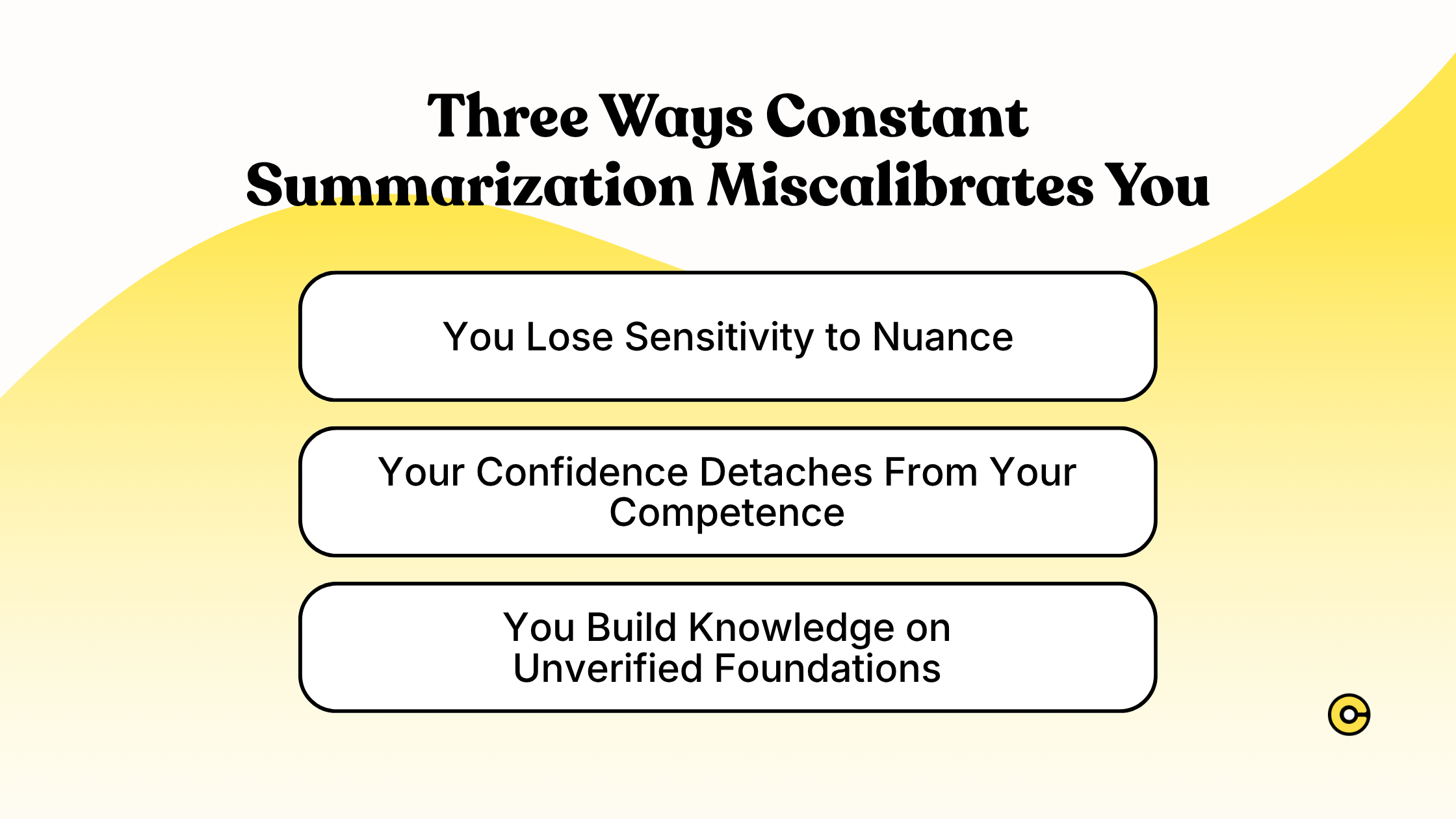
Three Ways Constant Summarization Miscalibrates You
1. You Lose Sensitivity to Nuance
Real understanding lives in the details: the exceptions, the contradictions, the "it depends." Summaries, by design, strip those out. They present the clean, confident version of a messy, conditional reality.
When you only ever see the cleaned-up version, you stop expecting mess.
You start believing that complex topics actually have simple answers. And that belief is exactly what makes miscalibration dangerous: you do not know what you are missing, because the summary never told you it was there.
2. Your Confidence Detaches From Your Competence
A 2024 study published in Journal of Vision confirmed what researchers have long suspected: metacognition is mentally demanding. It requires effort. When we consistently outsource the "thinking" part to summaries and AI tools, we are not just saving time - we are also skipping the very cognitive work that keeps our confidence calibrated.
Think of it like a muscle. If you never test your actual understanding - never try to explain something from scratch, never solve a problem without looking it up - your sense of what you know drifts away from what you can actually do. You feel like an expert. You perform like a beginner.
3. You Build Knowledge on Unverified Foundations
This is perhaps the most structurally dangerous consequence. When you accept a summary without verifying its underlying logic, you are not just making one mistake. You are using that summary as the foundation for your next decision, your next argument, your next project.
Miscalibrated knowledge compounds. One wrong assumption becomes the premise for three more. This is what we previously called the Error Loop, and the summary habit accelerates it, because summaries are consumed fast, forgotten fast, and rarely double-checked.
The AI Dimension: When Summaries Summarize Summaries
There is a newer layer to this problem that did not exist five years ago.
AI tools are now generating summaries of documents that were themselves summaries. We are building knowledge pipelines where the original source is three or four steps removed from what a person actually reads.
Each step introduces potential distortion, omission, and oversimplification.
Research on large language models confirms that they are particularly prone to surface-level outputs when faced with complex, unstructured material. They produce polished, confident-sounding text that covers the obvious points while completely missing the deeper logic. And because the output sounds right, users rarely catch the gaps.
This is not a criticism of AI tools - it is a description of how they work.
Pattern recognition is not the same as understanding. A model trained on millions of summaries will produce excellent summaries. But that does not mean those summaries capture truth.
When humans consume AI-generated summaries without critical evaluation, they are essentially reading patterns, not information. The confidence that comes with a well-formatted answer is borrowed, not earned.
Don't replace your thinking with AI. Extend it.
Cluing helps you collect sources, preserve context, organize your research, and use AI to synthesize ideas across your own knowledge - not just summarize a single article.
How to Summarize Without Outsourcing Your Brain
The goal here is not to stop summarizing. That would be both impractical and unnecessary. The goal is to summarize strategically in a way that builds understanding rather than replacing it.
Here is a practical framework:
- Before the summary: Know why you are reading it. Are you getting an overview to decide whether to go deeper? Or are you using it as a substitute for going deeper? The first is legitimate. The second is where miscalibration starts.
- During the summary: Resist the pull of fluency. When something reads smoothly, that is exactly when you should slow down and ask: "Does this actually hold up? What is being left out here?"
- After the summary: Test your understanding. Can you explain the core idea in your own words without referring back to what you just read? Can you identify what the summary did not cover? If you cannot, you do not yet understand it.
- When it matters: For decisions with real consequences - professional, financial, health-related - always trace back to primary sources. Do not build strategy on a summary of a summary.
 Gordana Laskovic
The Bigger Picture
Metacognitive miscalibration is not a personal failure. It is a predictable outcome of an information environment that rewards speed over depth.
And the habit of summarizing everything is not laziness. It’s a rational response to information overload. But rationality in the short term can be costly in the long term. When the gap between what we think we know and what we actually know grows wide enough, it stops being a personal inconvenience and starts being a systemic risk.
The antidote is not to read everything in full. It is to know when depth matters, to question fluency, and to regularly test your understanding against reality, not against another summary.
In other words: stay curious enough to be uncomfortable. That discomfort is your calibration signal. Do not outsource it.
For a deeper look at how metacognitive miscalibration works, and the habits that help you avoid it - read our full breakdown: Metacognitive Miscalibration: What It Is and Why It Matters.
FAQs 🧐
What is metacognitive miscalibration?
Metacognitive miscalibration is the gap between what you think you know and what you actually know. It happens when your confidence outpaces your real understanding of a topic.
How does summarizing everything cause metacognitive miscalibration?
When you consistently read summaries instead of full content, you get the illusion of understanding without the depth. Over time, your confidence stays high while your actual knowledge stays shallow.
Is summarizing always bad for learning?
No. Summaries are useful for getting an overview or deciding whether to go deeper. The problem starts when they become a substitute for deeper engagement rather than a starting point.
What is the illusion of knowing?
The illusion of knowing is when you believe you have understood something simply because you were exposed to it. Reading a well-written summary feels like comprehension, but it often is not.
How does AI make metacognitive miscalibration worse?
AI tools produce fluent, confident-sounding answers that feel reliable. This reduces our motivation to verify or think critically, reinforcing the gap between perceived and actual knowledge.
How can I tell if I am miscalibrated on a topic?
A simple test: try to explain the topic in your own words without looking anything up. If you struggle, your confidence likely exceeds your actual understanding.
What is the simplest habit to avoid metacognitive miscalibration?
After reading any summary, ask yourself what it left out. That one question forces your brain to engage critically instead of just accepting what felt complete.


![The Best Reddit Threads Disappear in a Week. Here's How to Keep Them [2026]](https://storage.ghost.io/c/9f/9d/9f9d32ee-55b4-4411-b435-9dc854e1751c/content/images/size/w600/format/webp/2026/06/reddit-cover.png)
![Read it later system for LinkedIn posts - Save, organize, and use what you find [2026]](https://storage.ghost.io/c/9f/9d/9f9d32ee-55b4-4411-b435-9dc854e1751c/content/images/size/w600/format/webp/2026/06/blog-3.png)


![Cognitive Capital - The New Layer of Value [2026]](https://storage.ghost.io/c/9f/9d/9f9d32ee-55b4-4411-b435-9dc854e1751c/content/images/size/w600/format/webp/2026/05/covers--9-.png)