



- Knowledge management is a system for making knowledge usable, not just stored
- The process has 6 key stages: identify, capture, organize, store, deliver, optimize
- Most teams fail after capturing knowledge in structure, access, and reuse
- Modern KM is shifting from static documentation to workflow-based intelligence systems
- The value lies in making knowledge usable in day-to-day work.
- AI is making knowledge systems more dynamic, searchable, and self-improving
While we often focus on crFeating and exchanging knowledge, that's not where knowledge management should stop.
The best practice is to divide it into 6 stages: Prioritize, Audit, Capture, Curate, Deliver, and Optimize.
1. Prioritize - Focus on Critical Knowledge
The first step in knowledge management is deciding what knowledge is worth keeping long-term.
Not everything needs to be stored. In fact, most information loses value quickly or gets replaced over time.
The goal here is to focus only on knowledge that:
- supports important decisions
- is used repeatedly in daily work
- helps teams avoid mistakes or repetition
- carries context that is hard to reconstruct later
A good way to approach this is to think in terms of usage, not volume:
What do people constantly rely on? What is hard to find when needed?
Once identified, knowledge can be labeled with a simple priority system such as:
- High priority - critical for decisions and execution
- Useful reference - helpful but not urgent
- Nice to know - optional context or background
This step ensures that your knowledge system stays focused and doesn't turn into a storage dump.
2. Knowledge Audit (a.k.a. Knowledge Identification)
A knowledge audit, also known as knowledge identification, is the process of reviewing what knowledge already exists in your system and identifying what is missing.
It helps you understand what your team already knows, where that knowledge lives, and where the gaps are.
Instead of starting from scratch, this step focuses on mapping your current knowledge landscape within your knowledge management system.
Recent industry research on knowledge management trends in 2026 shows that organizations are increasingly prioritizing visibility into existing knowledge and focusing on identifying knowledge gaps before creating new documentation or systems. This shift reflects a broader move toward more structured and efficient knowledge management processes, where audit and discovery come before creation.
A knowledge audit typically includes:
- Reviewing existing information within the categories you previously prioritized
- Identifying gaps by spotting repeated questions, unclear processes, or missing documentation
- Detecting duplicated, outdated, or conflicting knowledge across the system
The goal is simple: make sure you are not rebuilding knowledge that already exists, while clearly identifying what still needs to be created.
A strong audit ensures that effort goes into filling real gaps, not guessing what might be needed.
3. Capture - Collect and Acquire Critical Knowledge
Knowledge capture, also known as knowledge acquisition, is the stage where essential information is gathered from all relevant internal and external sources.
This stage focuses on gathering essential information from all relevant internal and external sources.
The knowledge must be accurate, up to date, and reliable. Outdated or incorrect data can lead to poor decision-making.
There are two core components of knowledge capture:
- Knowledge discovery: involves identifying and collecting existing knowledge that already lives inside the organization, such as:
- documents and internal resources
- tools and databases
- expert insights from team members
- existing workflows and processes
- Knowledge creation: focuses on generating new knowledge to fill gaps identified during the knowledge audit phase, such as:
- documenting undocumented processes
- capturing decision-making context
- creating new insights based on recurring problems or patterns
Effective knowledge capture ensures that critical information is available when it matters most, and not lost in day-to-day operations.
4. Curate and Organize - Structure Knowledge Effectively
After you capture critical knowledge, you need to curate and structure it so people can easily find, understand, and reuse it.
This stage makes information usable instead of fragmented and hard to navigate.
- Organize with purpose: Knowledge should be classified, categorized, indexed, and described in a way that aligns with how teams actually work, not just along departmental lines. Structure it based on workflows, use cases, or strategic priorities and recurring needs.
- Verify and refine: Evaluating stored knowledge is essential. It must be accurate, current, complete, and consistent. Remove anything that's outdated, redundant, or irrelevant to keep your knowledge base clean and reliable.
 Gordana Laskovic
5. Deliver - Share Knowledge When and Where It's Needed
Once you have captured and curated the knowledge, the next step in the process is to make the knowledge available.
Knowledge is only useful when people can actually reach it while they work.
- Knowledge Application: Pull and Push: This stage focuses on knowledge application, making information available in two ways:
- Pull: People can access knowledge when they actively search for it
- Push: The system proactively surfaces relevant knowledge to people who need it
- Preventing Knowledge Loss: When you distribute knowledge effectively, you prevent it from disappearing into scattered tools, conversations, or individual memory.
- And without proper delivery, even well-documented knowledge becomes invisible over time.
- Applying Knowledge in Practice: Delivered knowledge should directly support daily execution, including:
- answering questions faster
- making better decisions
- improving workflows and processes
- learning from existing knowledge to create new insights
A good knowledge management system (KMS) helps teams organize and validate knowledge. It's used to streamline all information found through previous phases and is usually implemented in the form of a software solution that makes the information more structured and searchable.
If you use a KMS to deliver knowledge, there are several things it can provide teams with:
- It can facilitate the delivery of information to the right people at the right time. The KMS can personalize content based on roles, personas, channels, and context.
- Role-based portals make knowledge accessible to different user groups, such as team leaders, knowledge managers, or partners.
- Knowledge can be flagged to ensure it is appropriate for a particular channel or for a particular use.
- Contextual information can be displayed to users so that, for example, new hires receive different information than more experienced members of the team.
 Gordana Laskovic
6. Optimize - Improve Knowledge Value with Analytics
A modern knowledge management system (KMS) that integrates machine learning and advanced analytics can significantly enhance the value of your organizational knowledge.
Areas that can be optimized include:
- Recognizing user intent
Understanding what users are really searching for allows the system to deliver the most relevant and context-specific answers. - Measuring Knowledge Effectiveness
By collecting feedback and analyzing user interactions, you can monitor how well the information meets users' needs and continuously improve content quality. - Identifying Knowledge Gaps
Analytics help spot missing information either directly - by asking users if their issue was resolved or indirectly by tracking user behavior and search patterns. - Evaluating Knowledge Impact
Use data to assess if your knowledge base addresses the most common questions and how it influences important business outcomes.
Optimizing knowledge management with analytics ensures your team always has access to relevant, actionable, and up-to-date information.
🎁 Bonus - Don't overengineer it
When building your knowledge management process, it's important to start small.
A simple FAQ in tools like Notion, Google Docs, or a lightweight tool like Cluing can be incredibly effective if it is:
- Searchable - easy for everyone to find the information they need
- Updatable - kept current with the latest knowledge and insights
- Collaborative - allowing team members to contribute and improve content
You don't need to implement all advanced steps at once. Understanding the options for enhancing your knowledge's value is what truly matters for long-term success.
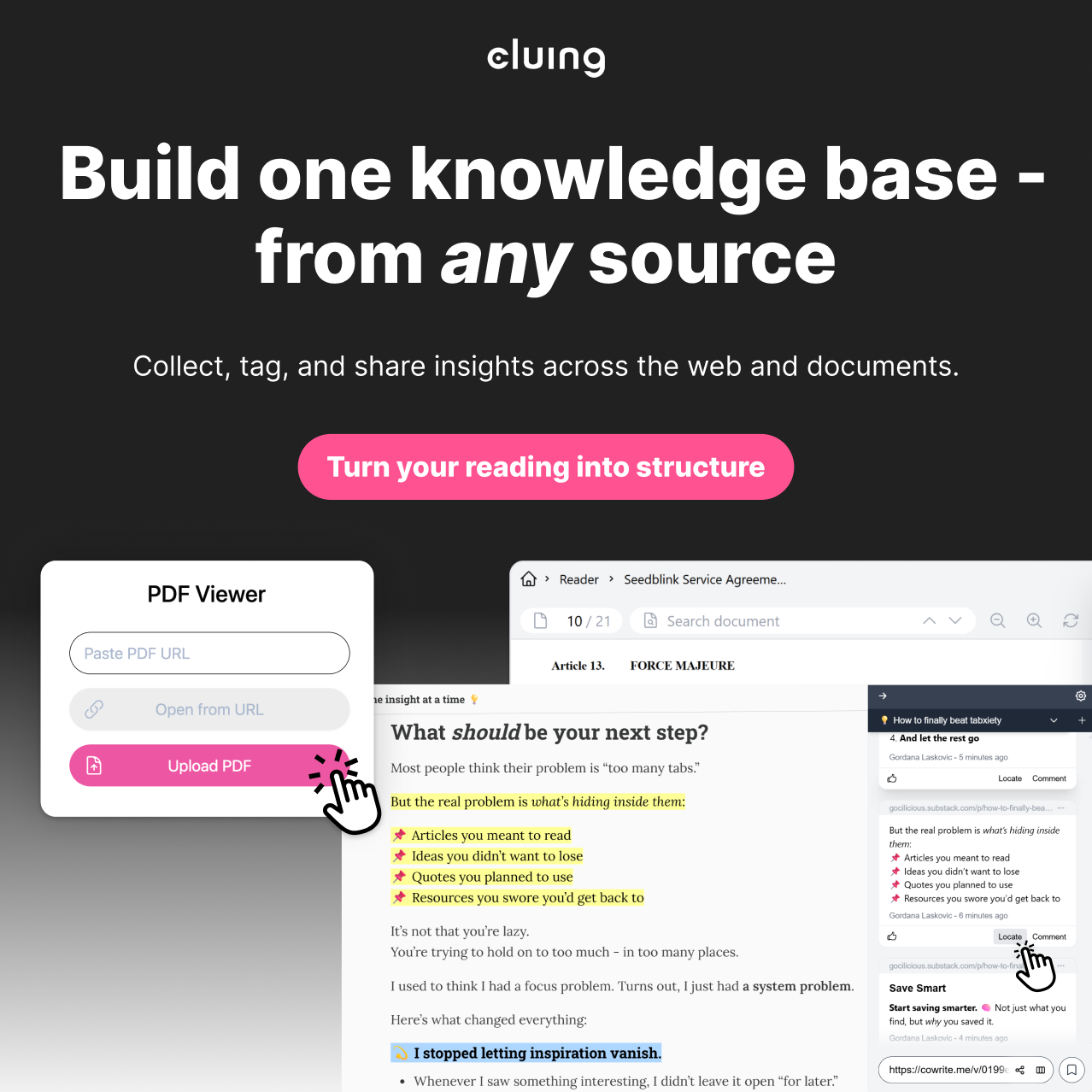
Manage Knowledge Smarter with Cluing
With Cluing, you can capture, organize, and share knowledge instantly. Highlight key info, save it, and collaborate with your team - all in one place.
Starting simple, whether with common tools or dedicated platforms like Cluing, can transform how you collect, organize, and use knowledge from day one, setting a strong foundation for future growth and better decision-making.
FAQs🧐
What is the knowledge management process?
The knowledge management process is a structured way of capturing, organizing, storing, sharing, and improving knowledge within an organization so it can be used effectively in daily work and decision-making.
What are the main stages of knowledge management?
The main stages include: prioritizing knowledge, auditing existing information, capturing knowledge, organizing it, storing it in a central system, delivering it where it’s needed, and continuously optimizing it.
Why is knowledge management important?
Knowledge management helps teams reduce repeated work, make faster decisions, and ensure important information is not lost across tools, people, or time.
What is knowledge capture in knowledge management?
Knowledge capture is the process of collecting important information from conversations, documents, systems, and people, and turning it into usable knowledge that can be shared and reused.
How do you improve a knowledge management system?
You improve a knowledge management system by analyzing how people use it, identifying gaps, updating outdated content, and optimizing structure and access based on real usage patterns and feedback.
What is knowledge optimization?
Knowledge optimization is the continuous process of improving the quality, relevance, and usability of knowledge using feedback, analytics, and user behavior data.


![The Best Reddit Threads Disappear in a Week. Here's How to Keep Them [2026]](https://storage.ghost.io/c/9f/9d/9f9d32ee-55b4-4411-b435-9dc854e1751c/content/images/size/w600/format/webp/2026/06/reddit-cover.png)

![Read it later system for LinkedIn posts - Save, organize, and use what you find [2026]](https://storage.ghost.io/c/9f/9d/9f9d32ee-55b4-4411-b435-9dc854e1751c/content/images/size/w600/format/webp/2026/06/blog-3.png)


